
New Year at a cemetery: A prophetic painting of our life
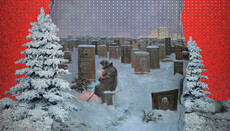
This is a publication about one painting. It depicts a woman who is not afraid of silence. A woman who is not afraid to look where others do not even dare to turn their heads. Every New Year’s night she spends not in a warm apartment at a festive table, but in a dark, cold cemetery among graves, completely alone. This woman was portrayed by Sergey Andriyaka. The painting is called New Year’s Night. It was created back in the distant year of 1984.
On the canvas is a real woman, and behind her stands a true story. She has been left alone in the entire world. Her daughter died, her home became empty. And now every New Year she buys a small Christmas tree and goes to the cemetery to meet the holiday there, together with her departed daughter.
The illusion of immortality
Now try to imagine yourself in this woman’s place. Everything that bound you to earthly life has passed into another world. Your only child lies in the grave. Feel the cold of the snow and the heat of the candle in your palm. Look from here, from the cemetery, at the distant city, at your former, ordinary life.
From this vantage point, everything seems so petty. All our grievances, the chase for money, our “important” everyday plans. Here only one thing remains – the Light you hold in your hands, and the love you keep in your heart. In this cold blue of snow there is more warmth than in the entire blazing city on the horizon.
We are used to thinking that life is there – where there are lights and movement. And that death is here – among the crosses.
But this painting reverses the perspective.
There, in the houses, is the illusion of immortality, the forgetting that everything is finite. People celebrate the change of calendar numbers, trying not to think about eternity.
Here, by the grave, is honest reality. There is no lie here. Here is the outcome to which all those now laughing in distant high-rises will come. This woman is wiser than all philosophers. On New Year’s night, when the world is intoxicated by the illusion of novelty, she looks eternity in the face. She knows the price of time.
Oysters and the air-raid siren
If I had not lived through what this woman lived through, I would neither write nor speak about it. But this painting is close to me. It is an icon of what I – and tens of thousands around me – am experiencing. Everything that connected us to our former life has been taken by the war.
For some, it was a childhood city or a parental home, as it was for me. Others lost not only their homes but also the dearest and closest people. I see before me the grief and tears of mothers like this woman in the painting. And I see cities beyond the cemetery.
There, well-fed “masters of life” eat delicacies and wash them down with expensive wine. In truth, it is not this mother’s daughter who is dead, but those people chewing oysters before blue screens, admiring the appetizing bodies of sexualized pop stars. Our grief is irrelevant to them. More than that – it even pleases them.
But there is one crucial point. Life exists where there is pain. Where pain turns into statistics, where grief becomes someone else's and distant, where the cold of indifference reigns, where “I” and “mine” are valued above all else – there is a cemetery of the dead.
The collective Pilate
Meanwhile, our cemeteries continue to be filled with newly killed children, and the blood of innocent people flows like a river. This is the blood of Abel, crying out from the earth to heaven. And God hears every one of our groans.
A time will come when the townsfolk, cheerfully eating Olivier salad and sandwiches on New Year’s night, will ask God, “Lord, when did we see You suffering?” And He will answer, “When you ate your fill and bathed in champagne spray, ignoring the suffering of others. When you preferred to step over Me while I was dying before your eyes.”
For me, this painting is not about 1984. It is about the New Year of 2026.
Only instead of silence there is the wail of an air-raid siren. And there sits a real woman whose home was bombed and whose only child was killed. She has nowhere else to go but to the grave. She has nothing left to dream of except to reach that cemetery as soon as possible, to be near her daughter.
Black holes in our souls
Now look again at the lights of the distant city. This is a world that continues to live as if nothing is happening. There they argue about which smartphone has the better camera. They plan vacations, laugh, kiss, shop – neon lights, glitter, charm, prestige, glamour. There it is warm, bright, and safe.
But that light now seems ominous to me. It is the light of ignorance and the refusal to know and to empathize.
It is a collective Pilate washing his hands before the Crucifixion of Christ. The snow-dark cemetery with crosses is the country in which I live. It is truly dark here – because electricity is gone for fifteen to seventeen hours a day.
We have fewer homes and fewer people, and ever more graves and missing persons. This painting is an icon of our present day. The woman sitting on the snow on New Year’s night is the image of hundreds of mothers who have lost their children. While the world feasts and celebrates, there are black holes inside our souls, blasted open by missiles.
Yet in the candle the mother holds in her hands there is hope – hope that this is not the end, and that the meeting with her daughter still lies ahead.
Where is your treasure?
“While there is even one hungry person in the world, you have no right to eat your fill,” said Elder Simon the Bloodless. But this is a global rule. While mothers’ tears are still flowing, while innocent people are dying, while blood is being shed and instead of joy and laughter there is the sound of sirens and exploding missiles, you have no right to live as if nothing is happening.
If, of course, you consider yourself a Christian. You have no right to the inviolability of personal happiness when there is so much misery around you. For that is exactly how Christ lived.
This war has shown again and again that the Gospel is not a kind fairy tale, but a harsh truth.
And this painting teaches us that love is stronger than death. That the true celebration is not at the table, but within the human soul. Today the world is divided between those who “buy oxen,” trying to preserve comfort at any cost, and those who force themselves to enter into the grief of others. The latter are very few, but they exist. This is that very little flock.
And one more thing that matters deeply. Today God weeps together with the woman on the cemetery snow, not laughing in the warm apartments of the indifferent. The painting asks the viewer an uncomfortable question: “Where is your treasure on this night?” If the end of the world came tomorrow, where would you be found? In what state would Christ encounter you – in drunken revelry at a table, or like this, in silence, with love and a candle in your hands?