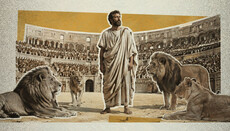




How Christians Abandoned Pacifism
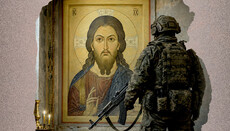
How the first Christians refused to kill on command – and what changed after Constantine.
Today, if an Orthodox priest in some Local Churches declares himself a pacifist, he will immediately be accused of the heresy of Tolstoyism and banned from ministry. All of this is because it is far easier for present-day theologians, who prop up state institutions with their authority, to argue with Leo Tolstoy as a historical figure than with Justin Martyr or Tertullian.
L. Tolstoy did indeed hold specific theological views: he denied the Divinity of Christ, the Resurrection, and the Sacraments, reducing Christianity exclusively to a moral teaching. By attacking Tolstoyism, his opponents strike at its rejection of the Church, pretending that the idea of nonviolence collapses along with it. But is this really the case? Was L. N. Tolstoy wrong when he argued that swearing an oath to the state and the readiness to kill on command contradict the primary allegiance – to God? Let us look truth in the face through the eyes of history.
And the first thing that cannot be overlooked is that the New Testament contains not a single quotation that would justify killing as such. There is not even a hint that a Christian has the right and duty to kill people. On the contrary, there are direct words affirming Christian pacifism. However one may attempt to reinterpret the Savior's words, He speaks plainly, without any allegory: "But I say to you, do not resist an evil person" (Matt. 5:39). Moreover, He repeats this more than once, though in different words.
The commandment that "greater love has no one than this, than to lay down one's life for his friends" (John 15:13) has never had any bearing on war, even defensive war. One could cite many other passages that testify to the New Testament being pacifist in its entire essence and meaning: (Matt. 5:38–39), (Matt. 5:44), (Matt. 5:9), (1 Pet. 3:9–11), (Rom. 12:17–21), (1 Pet. 4:15), (James 4:12), and others.
"Whoever hates his brother is a murderer, and you know that no murderer has eternal life abiding in him" (1 John 3:15).
Very well, but perhaps in historical records we might find some loophole suggesting that a Christian may after all take up arms and kill? The historical documents of the first centuries preserve the protocols of Roman courts (Acta Martyrum), which authentically recorded refusals of military service and the shedding of blood.
Saints Who Suffered for Refusing to Fight
Saint Maximilian of Tebessa (295 AD, Numidia). Conscripted into the Roman army as the son of a veteran, the 21-year-old Maximilian refused to take the military oath and to be measured for height. From the court record: – Maximilian: "I cannot serve, I cannot do evil. I am a Christian." – Proconsul Dion: "Serve, or you will perish." Maximilian was beheaded for refusing military service.
Saint Marcellus of Tangier (298 AD, Tangier). The centurion Marcellus, during a celebration in honor of Emperor Diocletian, publicly removed his military belt, threw down his centurion's staff and weapons before the troops: "I serve Jesus Christ, the Eternal King. From this moment I abandon the service of your emperors... It is not fitting for a Christian who serves Christ the Lord to fight for the kingdoms of this world."
At the trial before Prefect Agricolanus, Marcellus confirmed that military service required of him actions incompatible with faithfulness to Christ, after which he was sentenced to death by beheading. When the prefect read out the death sentence against Marcellus, Cassian – a court scribe (notarius) present at the proceedings – threw his stylus and writing tablets to the floor, declaring the sentence unjust and that he himself refused to continue serving a system that killed people for their faith and for refusing to shed blood. Cassian was immediately arrested and executed a few days later.
Saint Martin of Tours (c. 356 AD, Worms). The son of a Roman tribune. Having become a Christian, he remained in the legion until actual combat operations against the Alemanni began. On the eve of battle, during the distribution of combat bonuses, Martin addressed Caesar Julian: "Until now I have served you as a soldier; allow me now to serve God... I am a soldier of Christ, I am not permitted to fight." The Caesar grew angry and accused Martin of cowardice, claiming that he was hiding behind his faith out of fear of the coming battle rather than out of religious conviction. To prove that his motive was faith and not fear of death, Martin said that the next day he would stand at the head of the vanguard before the front line of troops, unarmed, without helmet or shield, protected only by the sign of the cross, but would not take up weapons.
Many other similar examples could be cited. But this is history – what did theologians teach on this matter? They built their arguments on direct adherence to the Sermon on the Mount and a literal reading of Isaiah's prophecy that people would "beat their swords into plowshares and their spears into pruning hooks" (Isa. 2:4).
The Rejection of Violence as a Marker of the New Man
One of the first great apologists, Justin Martyr (c. 100–165 AD), directly points out to the Roman emperor that this prophecy is being fulfilled right now – in Christian communities: "We who formerly killed one another do not only not make war with our enemies, but also, that we may not lie nor deceive our examiners, willingly die confessing Christ" ("First Apology").
The rejection of violence was perceived as the primary defining characteristic of the new man.
Irenaeus of Lyon (c. 130–202 AD) echoes him, emphasizing that Christians have beaten their weapons into peaceful instruments and no longer "know how to make war," preferring to turn the other cheek.
For the apologetic thought of the 2nd–3rd centuries, killing a person in war was no different from ordinary murder. The Bishop of Carthage, Cyprian, wrote in the 3rd century with bitter sarcasm about the double standards of pagan society: "If a murder is committed by a private person, it is considered a crime; but if it is committed in the name of the state, it is called valor. Not innocence is freed from punishment, but ferocity receives praise" ("Letter to Donatus").
If one looks at the surviving texts of the Fathers and teachers of the Church before the 4th century, not a single author can be found who would justify a Christian's participation in combat.
Tertullian (c. 155–220 AD), in his treatise "On the Crown," poses a rhetorical question: "Can it be lawful to make an occupation of the sword, when the Lord proclaims that he who uses the sword shall perish by the sword? And shall the son of peace take part in the battle when it does not become him even to sue at law?" In another work, "On Idolatry," Tertullian coins a formulation that became a classic of the early Church: "The Lord, in disarming Peter, unbelted every soldier."
Even Origen (c. 185–254 AD), defending Christians before the pagan Celsus, who accused the community of being unpatriotic and refusing to defend the empire, proudly confirmed this fact. Origen did not deny that Christians refused to take up arms, but explained it as a higher service: "Christians do more good to their country than the rest of mankind, since they educate the citizens and teach them to be devoted to God... Christians do not enlist in the army even if the emperor compels them, but they fight for him by offering prayers to the Deity" ("Against Celsus," Book VIII).
Lactantius (c. 250–325 AD), whose works summed up the era of persecutions, concludes regarding the commandment "Thou shalt not kill": "It will not be lawful for a just man to serve as a soldier, for justice itself is his military service... There ought to be no exception at all to the divine commandment that it is always a sin to kill a man" ("Divine Institutes").
It is also very interesting to examine pacifism from a canonical perspective.
Pacifism and the Canons
The "Apostolic Tradition" (Lat. Traditio Apostolica) – a liturgical-canonical document of the 3rd–4th centuries (traditionally dated to c. 215 AD), the authorship of which was previously attributed to the Holy Martyr Hippolytus of Rome (in modern scholarship the document is considered an anonymous collection). This text contains the most detailed set of rules of the early Church regarding the selection of candidates for catechesis (instruction) and baptism.
The rules concerning military service and state offices are set out in Chapter 16 of the document ("On Professions and Occupations"). They divide military candidates into several categories:
- Rulers and military commanders: "A military commander or civil magistrate that wears the purple must resign or be rejected." Civil and military officials who had the right to pronounce death sentences (ius gladii – "the right of the sword") could not be received into the Church until they resigned from their position.
- Ordinary soldiers (reception as catechumens): "A soldier who is under authority must not kill a man. If he is ordered to do so, he must not carry out the order, and he must not take the oath. If he is unwilling to comply, he must be rejected." An ordinary soldier could become a catechumen and receive baptism only on the condition of a complete refusal to shed blood and to participate in the sacred military oath.
- Believers and catechumens who wish to join the army: "A catechumen or a believer who wishes to become a soldier must be rejected, because they have despised God." If an already baptized Christian or a catechumen voluntarily decided to enter military service, he was rejected. Voluntary enlistment in the army was equated with apostasy.
In the later Eastern recensions (in particular, in the "Canons of Hippolytus"), this discipline was adapted to new realities:
- Canon 13: "Concerning one who holds a civil office or commands troops: let him refrain from the sin of bloodshed."
- Canon 14: "A Christian must not voluntarily become a soldier, unless compelled to do so by a superior... But if he sheds blood, he must not approach the Sacraments until he has been cleansed through repentance."
The "Apostolic Tradition" records the historical moment when the Church regarded itself as the "army of Christ," whose methods of struggle are exclusively spiritual, and direct participation in state violence was considered incompatible with Eucharistic communion.
The pacifism of the first Christians was not the result of cowardice or political protest. It was a radical choice in favor of the "Kingdom not of this world."
They believed that the cross, suffering, and the forgiveness of enemies were the only instruments by which Christ conquered evil, and therefore the use of violence to defend even the most "just" cause destroys the very essence of the Gospel.
The turning point came in the 4th century with the Edict of Milan and Emperor Constantine's conversion to Christianity.
When the Church transformed from a persecuted minority into the state religion, the need arose to justify state institutions, including the apparatus of violence. Already at the Council of Arles (314 AD) a step was taken toward canonizing military service, and a century later Blessed Augustine formulated the concept of the "just war." Subsequently, the theology of the "just war" was elaborated by Thomas Aquinas and definitively codified in the works of Francisco Suárez. Later, elements of this theological tradition also influenced Eastern Christian thought.
Yet the voice of the first centuries – of Tertullian, Justin, Origen, and thousands of martyrs – remains an unambiguous testimony in history: in the era of its purest and most uncompromising ardor, the Church of Christ firmly believed that hands which receive the Eucharist cannot be defiled by the sword and by blood.