



Why did God need the desert?
The Judean Desert begins almost at Jerusalem’s doorstep. A few hours on foot, and the city gives way to nothing but stone, heat, and silence.
In Hebrew, the word for “desert” is midbar. It shares its root with davar – “word,” “to speak.” For the ancient Semite, the desert was not a place emptied of everything. It was the place where God speaks. Or, more precisely, the place one withdraws to in order at last to hear what He had been saying all along while we, for our part, could not hear Him.
The prophet Hosea conveyed the Lord’s words about Israel, and they sound like the confession of a lover carrying his beloved away from the city: “Therefore, behold, I will allure her, and bring her into the wilderness, and speak tenderly to her” (Hos. 2:14). For this heart-to-heart conversation with man, God chose precisely this desolate place. And not without reason.

The border between life and death
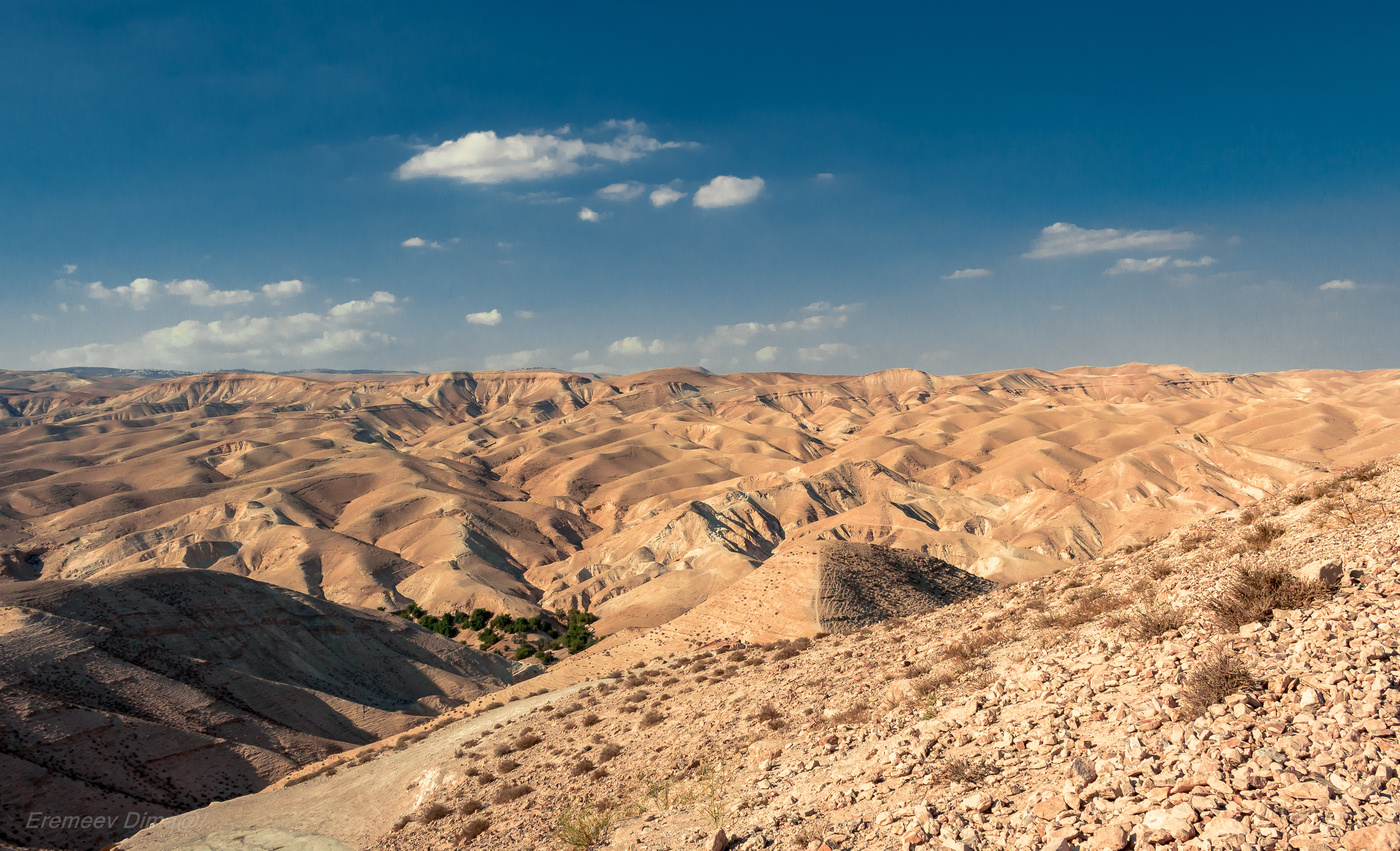
The Judean Desert is not the endless Sahara, but a local anomaly created by the land itself. Moist winds from the Mediterranean climb the western slopes of the Jerusalem hills and pour out rain over olive groves and vineyards. But once they cross the watershed, the same wind turns dry and scorching, and within a matter of miles transforms the eastern slopes into burned-out stone. On one side of the ridge – life. On the other – nothing. The descent from Jerusalem to the Dead Sea drops about 1,200 meters. It is a walk from the city to the lowest point on dry land, and it takes only a few hours.
This is what startles you when you begin reading the Gospel with a map in hand: John the Baptist preached not in some unreachable wasteland, but practically on the outskirts of the capital. The people of Jerusalem went out to him covering no greater distance than city dwellers today driving out to their country homes. The contrast was not geographical, but ontological: from the splendor of the Temple and the crush of the city, people descended in half a day into a place where there was nothing but rock, sky, and the voice of a solitary man clothed in camel’s hair.
The place where sins were cast away
In the Old Testament, this desert bore yet another meaning. On the Day of Atonement – Yom Kippur – the high priest laid his hands upon the scapegoat, transferring onto it all the sins of the people, and the goat was led away precisely here, to the precipice of Azazel in the Judean Desert (Lev. 16:21–22). The desert served as a kind of quarantine zone for evil.
Panorama of the Judean Desert
And when we read that after His Baptism in the Jordan, Christ was led by the Spirit into the wilderness for forty days, we need to understand where exactly He went.
He went to the place where for centuries human sin had been cast away – onto the “enemy’s territory,” onto “contaminated ground.” He entered the battle where evil felt itself master.
Murderous rivers
This desert looks dead. But it deceives.
In winter, when rain falls over Jerusalem, the water does not soak into the rocky ground of the eastern slopes. Instead, it rushes downward through the dry canyons – the wadis. A wall of water several meters high forms and sweeps away everything in its path. The sky above the desert itself may be utterly clear – the storm may have broken beyond the ridge, twenty kilometers away – yet the torrent is already here, and in a narrow gorge there is no escape from it. Israel’s rescue services record deaths in the wadis every year: those who camp for the night in a dry riverbed often never wake up.
Life in this desert demands what the ascetics called sobriety – unceasing vigilance. Relax, and you die. Such is the truth of life in the bosom of Palestinian nature.
A terrifying silence
Guides who lead pilgrim groups to the monasteries of the Judean Desert – to St. Sabbas the Sanctified, to Wadi Qelt and St. George of Choziba – speak of the same reaction again and again among city people. Once cell service disappears and all that remains are the blazing walls of the canyon, some in the group begin to feel anxiety, sometimes even panic. People accustomed to an uninterrupted flow of information suddenly find themselves in sensory emptiness and cannot endure it. Suppressed fears, long drowned out by news feeds and background music, rise to the surface within minutes.
This is precisely why the monks of the fourth century came here. Not to hide from the world, but to confront what the world had never allowed them to notice.
St. Anthony the Great began his подвиг in the desert, and thousands followed after him. Blessed Jerome, who settled in Bethlehem, wrote of the desert with astonishing tenderness: “O desert, bright with the flowers of Christ! O solitude, in which are born those stones from which, in the Apocalypse, the city of the Great King is built!”
A vault for the Word of God
In 1947, a Bedouin boy searching for a lost goat in the caves near the Dead Sea threw a stone into the darkness and heard the sound of shattering clay. That is how the Qumran Scrolls were discovered – the oldest biblical manuscripts, which had lain hidden in the caves of the Judean Desert for around two thousand years. The dry, salty, lifeless microclimate that kills all living things on the surface proved to be the perfect preservative for parchment. Moisture destroys paper – it rots, molds, and crumbles. Dryness preserves it.
Here one senses the mystery of divine Providence: the place that seems least fit for life became the place where His Word was preserved most perfectly.
Midbar – the place where God speaks – became also the place where His speech was inscribed upon stone and kept in clay jars, untouched by time.
We are used to thinking of emptiness as punishment. Silence frightens us, loneliness oppresses us, and the absence of incoming messages makes our fingers itch. But again and again God leads His chosen ones into the desert: Moses, Elijah, John the Baptist. In the end, Christ Himself withdraws there. And each time, the righteous return from it carrying something they could never have received in the city – a particular revelation, which they then handed on generously to the people of Israel, and through them, to all of us.