
The heresy of one will – a peace that betrayed the truth
Anyone who has ever sat in a meeting where the boss is plainly lying and colleagues carefully keep silent knows the feeling. You hear the falsehood, catch a warning glance – you’re not going to speak up now, are you? And so you stay quiet. Later you find an excuse: it’s nothing, not worth the conflict. That is how the oldest trap in the world begins.
A crack covered over
A crack runs through a load-bearing wall. Not yet through-and-through, but deep. A good foreman will say: the frame must be dismantled and rebuilt – long and costly work. A bad one will take filler and carefully smooth over the line. A fresh coat of paint goes on top. The wall looks perfect. Until the first serious strain. It was precisely such workmanship that nearly destroyed the Church in the seventh century.
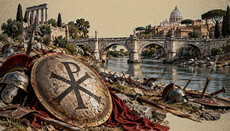
At that time, Byzantium was quite literally splitting apart. Arab armies were seizing vast territories – first Syria with Palestine, then Egypt. In these eastern provinces lived millions who, since the Council of Chalcedon, had rejected its decisions. They were called Monophysites. They confessed one nature in Christ, not two, and had no desire to fight in the imperial army to defend a “foreign faith.” The emperor urgently needed to win them back.
Thus, in Constantinople, a diplomatic formula was born. It was proposed by Patriarch Sergius – a knowledgeable and cautious man. His reasoning was simple: let us set aside the dispute over two natures. We acknowledge two natures. But Christ has one will – divine. This would satisfy both the supporters of Chalcedon and those who had broken away. The idea was supported by the emperor Heraclius.
Of course, the story was more complex than a mere bargain. Sergius was not seeking cynical deception but a theologically acceptable bridge between hostile camps. The trouble was that this bridge was built on sand.
Gethsemane without pretense
All this may sound like a subtle theological nuance, hardly worth breaking spears over.
In reality, it is no nuance at all. The will (in Greek, thelēma) is not simply what one “wants” or “doesn’t want.” It is the source of every choice. If Christ had only a divine will, then He had no human will. And if He had no human will, then that terrible and bloody night in the Garden of Gethsemane – when He prayed, “Father, if You are willing, take this cup from Me; nevertheless, not My will, but Yours be done” (Luke 22:42) – becomes incomprehensible.
Worse still, the consequences run deeper. If Christ did not assume the human will – that stubborn, wavering will that struggles within each of us – then He did not heal it. Salvation becomes inaccessible precisely at the point where we are most wounded: in our ability to choose between good and evil.
Outwardly, everything looks attractive: “Let us simply agree for the sake of peace.” Inwardly, God becomes a distant observer, and man is left alone with his demons.
The filler lies smooth. The house stands. Until the first blow.
The edict of silence
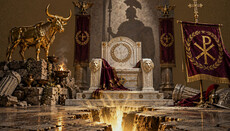
When even the “compromise” failed to end the dispute, Emperor Constans II in 648 issued a document known as the Typos – a “Model of Faith.” Its cunning lay in the fact that it did not declare heresy as dogma. It simply forbade discussion of the issue. Texts mentioning the wills were ordered removed from the gates of Hagia Sophia. Those who continued the debate faced loss of property, rank, or even public flogging.
The state officially declared: Truth is a detail not worthy of your attention. Be silent for the common good.
And the most troubling part of this story is not the emperor, nor the theologians who devised the formula, but the behavior of ordinary clergy. A large portion of the hierarchy and tens of thousands of priests from Rome to Antioch were not fanatics of the convenient formula. They simply received a document from above: “For the sake of peace and unity, do not preach on this topic,” and filed it away. They had families, parish debts, children to feed. An era is shaped less by villains at the top than by the lukewarm majority willing to accept a “reasonable compromise.”
The price of a cut tongue
Pope Martin was dragged by imperial agents from the Lateran Palace on a stretcher – he was gravely ill. He was brought to Constantinople, paraded through the streets in chains, publicly stripped, and then exiled to Chersonesus, present-day Sevastopol. There he died of hunger, writing in his final letters: “I was and still am amazed at the senselessness and hardness of heart of all those who once belonged to me… they have entirely abandoned me and do not even wish to know whether I am alive.” The flock chose the “peaceful option” and forgot their Primate.
And there was the elder Maximus the Confessor. When he was brought for interrogation in 655, they pressed him not with theology but with simple arithmetic: “Because of your disputes, Syria and Egypt have fallen. The hierarchs of the Universal Church have accepted the peaceful agreement. You alone stand against all.”
The logic was flawless – as it always is in any society: the majority is the majority.
1.jpeg)
Maximus replied: “I do not wish to be a heretic. As for the emperor’s prohibition, I have the commandment of God: ‘Whoever is ashamed of Me before men, of him will I also be ashamed before My Father in heaven.’”
And he added words that ought to be engraved in granite in every Christian soul: even if the whole world were to receive Communion with heretics, he alone would not.
They could not persuade him. Then the authorities, cloaking themselves in words of peace and love, resorted to another method. They cut out the elder’s tongue so he could no longer preach. They cut off his right hand so he could no longer write. He was exiled to the Caucasus, to present-day Georgia, to a place called Tsageri. There Venerable Maximus died.
And here is what gives this story its final weight. The political calculation ultimately failed. The convenient formula did not return the lost provinces, and the Arab conquests continued unabated. The theological compromise promised much – and delivered nothing.
About twenty years after the death of the mutilated and nearly forgotten elder, the Sixth Ecumenical Council was convened in Constantinople. And there the same empire that had torn out his tongue officially recognized: his confession was true, and those who signed the convenient formula were to be condemned.
One man who refused to abandon the Truth proved stronger than the entire machinery of the state.
The heresy of the “one will” is no longer heard in theological formulas. But its principle lives on and works every day: “Keep quiet. Don’t get involved. These are our own – we still have to live with them.” Every time we hear an obvious falsehood and nod along, we choose the Typos. Every time we are afraid to speak the truth plainly and choose a diplomatic formula instead, we take the side of those who filed the paper away.
True peace is not born from a covered-over crack. It is born where the crack is seen, named, and repaired – even when it is costly and difficult.