
The Cross on the Spear of Roman Triumph
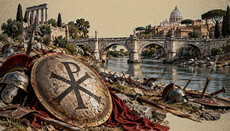
In our previous publication, we examined the battle of Constantine against Maxentius at the Milvian Bridge in 312. According to later church tradition, before the battle a sign of the cross appeared in the sky, and Christ himself commanded that a cross be inscribed on the soldiers' shields, saying: "By this sign, conquer." After such a clear sign and such a brilliant victory, by all logic, both the Cross as a symbol and Christianity as a highly moral teaching should have transformed both imperial policy and the emperor's own conduct.
But something else happened instead.
A severed head on a spear
Maxentius perished on October 28, 312, drowning in the Tiber during the retreat. His body was found, desecrated and mutilated; his head was then severed, mounted on a spear, and carried through Rome the following day at the head of Constantine's victory procession. The modern historian Johannes Wienand draws attention to the unusual nature of what took place. As far as the sources allow us to judge, this was "the first instance in which the severed head of a deposed emperor was carried on a spear through the city during a Roman triumph." The fact that Constantine was married to Maxentius's sister adds further unpleasantness — meaning the severed head of his own brother-in-law was carried before him.
Maxentius's head was later sent to Africa. The panegyric of Nazarius from 321 explains this gesture with perfect clarity: "to pacify Africa."
Pagan bas-reliefs on a Roman arch
Already in the Ecclesiastical History, Eusebius of Caesarea claims that after the victory Constantine gave thanks to God and ordered that "the saving sign of the Cross" be placed in the hand of his statue in one of the most frequented places in Rome. On it, according to Eusebius, was an inscription: "By this saving sign... I have freed your city from the yoke of the tyrant." However, the existence of such a statue is not confirmed by any other contemporary source, and there is no archaeological evidence of its existence.
But there is another monument, very well preserved, which interprets Constantine's victory in a decidedly non-Christian spirit.
But there is another monument, very well preserved, which interprets Constantine's victory in a decidedly non-Christian spirit.
In 315, that is three years later, the "Arch of Constantine" was solemnly dedicated in Rome, commemorating the victory over Maxentius. It still stands there today, next to the Colosseum. It depicts Constantine offering sacrifices to the pagan deities Apollo, Hercules, Silvanus, and Diana. An interesting detail: some of the bas-reliefs were taken from older imperial monuments of the second century, and the sculptors who made the arch simply carved the faces of Constantine and his associates over the originals.
The arch bears no Christian symbolism whatsoever, but does feature depictions of deities traditionally associated in Roman culture with military victories: Roma, Victoria, and Mars. There is also a large inscription stating that Constantine defeated Maxentius "by the inspiration of the divinity."
Based on the available sources, we cannot state with certainty that Constantine offered sacrifices to idols after 312 or attributed his victory to pagan deities. But the fact remains: the Arch of Constantine was designed to create precisely that impression among Romans — and to do so for centuries.
The title of pagan high priest
As is well known, Christianity from the very beginning took an extremely negative view of the veneration of pagan deities: "What accord has Christ with Belial? Or what portion does a believer share with an unbeliever? What agreement has the temple of God with idols?" (2 Cor. 6:15–16). Ancient Judaism took the same view: "For all the gods of the nations are idols, but the Lord made the heavens" (Ps. 96:5).
The absolute incompatibility of Christianity and idol worship was well understood, yet Constantine bore the title of high priest (pontifex maximus) right up until his death. An official letter from Constantine and his sons to the Roman Senate, dated 337, has survived. Among his other titles, Constantine styles himself: pontifex maximus.
And in those times this was no mere decoration. The emperor as high priest was the chief member of the priestly college and the head of the state religious system. His duties included maintaining the proper relationship between Rome and the gods (pax deorum). Though, we repeat once more, there is no evidence that Constantine personally offered sacrifices.
And in those times this was no mere decoration. The emperor as high priest was the chief member of the priestly college and the head of the state religious system. His duties included maintaining the proper relationship between Rome and the gods (pax deorum). Though, we repeat once more, there is no evidence that Constantine personally offered sacrifices.
In 316, a coin was issued depicting Constantine together with the deity Sol Invictus (the Unconquered Sun). The British Museum, which holds one of these coins, draws attention to the paradox: the coin was issued nearly four years after the traditional date of Constantine's conversion to Christianity.
In traditional Roman religion there existed priestly diviners known as haruspices. In 319, Constantine forbade them from secretly visiting private homes, fearing political conspiracies, but urged anyone who wished to use their services to go "to the public altars and shrines." And in 320 he issued an order that if lightning struck the imperial palace or another public building, one should — "preserving the custom of ancient tradition" — consult the haruspices, determine what the omen signified, carefully record their interpretation, and "report this to the emperor himself." This order is preserved in the surviving legal code known as the Codex Theodosianus.
Bloody executions within the imperial family
The methods of the struggle for power after 312 likewise did not change.
In 313, Constantine and Licinius — who governed the Western and Eastern parts of the empire respectively — met in Milan. There they issued a joint edict of religious toleration and also became related by marriage. Licinius married Constantine's sister Constantia. But already from 316 onward, civil war broke out between the two rulers over supremacy in the empire. Eutropius, a Roman official and historian of the fourth century, writes plainly that Constantine, "striving for dominion over the entire world," went to war against Licinius despite their family ties.
Constantine won a series of military victories, but Licinius managed to retain power over the East, and in 317 a new peace was concluded between them. To strengthen it, two of Constantine's sons — Crispus and Constantine II — along with young Licinius the Younger, son of Licinius and Constantia, were simultaneously proclaimed Caesars. But a few years later the civil war resumed, and in 324 Licinius, having lost several battles, surrendered under guarantees that his life would be spared. He was declared a private citizen and sent to Thessalonica. However, within just a few months he was executed on Constantine's orders. Eutropius states that this was done "in violation of the oath given by Constantine."
In 326, Constantine ordered the execution of his eldest son Crispus — the very same Crispus who, on a coin of 322–323, is depicted with a Chi-Rho monogram on his shield. Crispus had been a successful military commander and just two years earlier had commanded the fleet in the war against Licinius. Aurelius Victor, a Roman historian and state official of the fourth century writing relatively close to the events, states plainly that Crispus perished "by his father's sentence... for what reason is unknown." Later sources explained this execution by claiming that Crispus had allegedly been involved with his stepmother Fausta. However, this version is considered too late and too contradictory to be reliable.
At roughly the same time, and also on Constantine's orders, his nephew Licinius the Younger was executed — a boy of about ten years of age. The sources attribute no specific crime to him, and the most obvious explanation is the elimination of a potential representative of the defeated Licinian dynasty.
Then, in that same year, the turn came for Constantine's wife Fausta. Here the degree of certainty that she died specifically on Constantine's orders is somewhat lower, though most scholars consider it highly probable. This is indirectly confirmed by the fact that after the deaths of Crispus and Fausta, references to them were removed from numerous documents and other records. Zosimus, a pagan historian of the late fifth to early sixth century, provides some details. He claims that after the execution of Crispus, Constantine ordered Fausta to be locked in an overheated bath, where she perished. But this version is considered equally possible alongside other accounts.
Eutropius, who is regarded as a fairly impartial historian with respect to Constantine, sums up the results of his reign as follows: "In the early part of his reign he might have been compared to the best princes; in the latter part only to those of middling character."
Eutropius, who is regarded as a fairly impartial historian with respect to Constantine, sums up the results of his reign as follows: "In the early part of his reign he might have been compared to the best princes; in the latter part only to those of middling character."
Eutropius then lists Constantine's virtues: military ability, success in wars, generosity, and an interest in peaceful pursuits and education. But he goes on to write that after the victory over Licinius and the acquisition of sole power, his character changed: "The arrogance bred by success altered Constantine somewhat from his former affability of character." Eutropius writes that Constantine "put to death an outstanding man — his own son, then his sister's son, a young man of good character, then soon his wife, and afterwards numerous friends."
The harsh laws of a new age
Eutropius also evaluates Constantine's legislative activity: "He enacted many laws: some good and just, most superfluous, some harsh."
There are indeed numerous examples of "good and just" laws. For instance, in 315 Constantine ordered that state funds be used to assist parents who, due to poverty, could not feed a newborn child, so that need would not drive them to infanticide or abandonment (Codex Theodosianus 11.27.1–2). Around 315–316, the emperor forbade the branding of convicts on the face, since the human face is made "in the likeness of heavenly beauty"; branding was permitted only on other parts of the body (CTh 9.40.2). In 320, Constantine demanded improvements in the treatment of prisoners: they were not to be kept in shackles "biting into the bones," they were to be given daylight, and no one was to die of hunger or exhaustion before trial. In 321, the manumission of slaves performed in church before a bishop and congregation received legal force, which considerably simplified the obtaining of freedom (CTh 4.7.1). Under Constantine, crucifixion as a criminal punishment was also abolished, though the exact date of this measure is unknown.
But alongside these laws existed those very "harsh" ones of which Eutropius wrote.
But alongside these laws existed those very "harsh" ones of which Eutropius wrote.
Here are a few examples. In 313, an official of the imperial estates found guilty of extortion was to be burned alive (CTh 10.4.1). In 315, a slave or freedman guilty of abducting a free person was to be thrown to wild beasts. In 318–319, Constantine reaffirmed the ancient "punishment of the sack" for those who murdered close relatives. The condemned was sewn into a leather sack together with snakes and thrown into the water (CTh 9.15.1).
In 319, a law was issued concerning the killing of slaves. If a slave died after the master had beaten him with rods or straps "for correction," or had kept him in chains, this was not considered murder (CTh 9.12.1).
Particularly harsh was the law of 326 concerning the abduction of girls. A nurse who had assisted in an abduction was to have molten lead poured into her mouth and throat (CTh 9.24.1). Another law prescribed the death penalty for a free woman who had relations with her own slave: the woman was executed, and the slave was burned alive (CTh 9.9.1).
The difficult path of transforming power
The year 312 was not the moment of birth of a "Christian empire," but the beginning of a long and contradictory transition. Constantine gave the Church freedom, protection, and state support, yet pagan symbolism and the influence of priestly institutions did not disappear. And the methods of the struggle for power, along with inhumane legal norms in certain cases, became even more brutal.
The Church venerates Constantine as Equal to the Apostles, and indeed his merit lies in the fact that the Church acquired a more privileged status, and its subsequent development followed the path we know. But the recognition of a person as a saint does not canonize all of his actions. Church hagiography can speak freely of the individual errors and even sins of the saints.
All the more so, an honest conversation about a man whose decisions determined the fates of millions and who influenced the subsequent history of humanity requires seeing not only the hagiographic image, but also the reality of his era. Otherwise it is easy to distort not so much the image of Constantine himself as the meaning of the Cross.
The Cross as a symbol entered into power earlier than Christian teaching was able to transform power itself.
The Cross as a symbol entered into power earlier than Christian teaching was able to transform power itself.
In our next publication we will look at how the Cross became not only a religious but also a state symbol, and will also attempt to examine what Saint Helena may actually have found in Jerusalem.