
Prayers for Christian unity from those who stand with persecutors
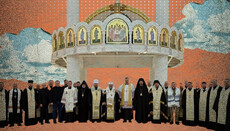
On January 24, 2026, Ukrainian Catholics of the Byzantine rite held an interconfessional prayer service for “Christian unity” in their so-called “Patriarchal Cathedral.” This year’s slogan was: “One Body. One Spirit. One Hope” (Eph. 4:4). Representatives of several other confessions took part in this ecumenical act: the OCU, the Ecumenical Patriarchate, the Ukrainian Christians of Evangelical Faith, the Ukrainian Christian Evangelical Church (the latter two are distinct denominations), the Lutheran Church, a Jewish Messianic community, and the Armenian Apostolic Church.
Fine and proper words were spoken in the cathedral. And unity, it would seem, is a good thing. But there is one detail. This event is taking place in a country where the authorities have unleashed persecution against the largest Christian confession. Its churches are being seized; it is branded as “traitors” and “collaborators”; the most inconvenient are thrown behind bars, and so on. But the most disgraceful part is that the country’s other religious confessions not only refuse to speak in defense of the persecuted Christians, but openly show solidarity with the persecutors, helping to destroy the Ukrainian Orthodox Church. In other words, they prayed for unity without the UOC – a Church that has nearly more communities than all the participants of that ecumenical service put together.
The All-Ukrainian Council of Churches against the UOC
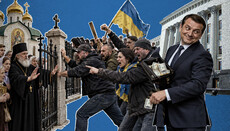
Religious leaders who call themselves Christians are siding with those who persecute Christians. It is hard to grasp, but this is the reality of today. In August 2024, on the eve of the Verkhovna Rada vote on a law banning the UOC, Volodymyr Zelensky met with the leaders of confessions at the All-Ukrainian Council of Churches – and those leaders, without the slightest shame, supported the ban on the UOC. Here are a few quotes:
Head of the OCU Serhiy Dumenko: “From the outset we supported and will continue to support those legislative changes that will help protect Ukraine’s spiritual space from the ‘Russian World.’”
Head of the UGCC Sviatoslav Shevchuk: “We unconditionally support everything the state is doing to ensure the realization of Ukrainian citizens’ rights to religious freedom. The responsibility of the state to prevent interference by the aggressor state in matters of religious freedom is a sacred right and duty of the state.”
Roman Catholic Bishop Vitaliy Kryvytskyi: “We support all the initiatives that have been mentioned earlier. It is known which organization is meant. Up to this time it has taken no concrete steps to separate itself and to condemn. Therefore we understand the necessity of the corresponding draft law.”
Chief Rabbi of Ukraine Yakov Dov Bleich: “It is necessary that God grant you wisdom, so that we may see this legislative act (the law banning the UOC – Ed.) as one that unites society and will build a good Ukraine.”
Let us think about this. These people speak in favor of banning a confession that unites around six million Ukrainian citizens (in the view of government representatives), while perfectly understanding that the UOC stands for Ukraine’s independence and sovereignty, that it is not dependent on the Russian Orthodox Church and is not under its influence, that it helps the Armed Forces of Ukraine, and so forth. They understand that banning a multi-million-member confession does not unite Ukraine, but rather divides it in the face of the enemy. And yet they still support the ban. Why?
Are they trying to remove a “competitor”? Are they doing what pleases those in power? And how can such a position be reconciled with Gospel truth?
Hypocrisy wrapped in beautiful words
If we look at the recent ecumenical prayer service for unity from this angle and listen to what was said there, everything takes on a different light. For example, Armenian Bishop Markos Hovhannisyan said: “The Week of Prayer for Christian Unity invites us to stop, to listen, and to remember who we truly are in Christ. Before belonging to any tradition, confession, or nationality, we belong to Him.”
In light of the All-Ukrainian Council of Churches’ support for banning the UOC, how are we to understand these words? Does “any tradition, confession, or nationality” include the UOC as well, or is it excluded? Do the six million faithful of the UOC belong to Christ or not? If not, then what unity can one even speak of? And if yes, then why do you not speak out in their defense?
From the same Armenian bishop’s sermon: “Before speaking about divisions, challenges, or unfinished work, we are called to acknowledge what already unites us: one body, one spirit, one hope.”
If the members of the All-Ukrainian Council of Churches truly thought as Markos Hovhannisyan speaks, they would first of all acknowledge that the UOC is the Church of Christ, that it is part of the Lord’s Body, that it has the very same hope of resurrection and eternal life. And only then would they speak of “divisions, challenges, or unfinished work.” Yet nothing of the kind has been heard in recent years about the UOC from Markos Hovhannisyan – or from any other religious leader.
Another quote: “God created us in the beautiful diversity of languages, cultures, traditions, and history. <…> Saint Paul never speaks of one culture or one style of worship. He speaks of one body.”
Excellent. But then why is the UOC denied the right to serve in Church Slavonic and to live by the Julian calendar? Why, when UOC believers celebrate the Nativity of Christ and other feasts according to the old style, are they accused of “Kremlin propaganda”? Why do the church traditions and canons observed by the UOC become grounds for a legislative ban – while other religious confessions support that ban?
Markos Hovhannisyan: “Unity does not grow through pressure, coercion, or forced agreement. It grows through humility that knows how to listen, patience that endures, and love that is ready to bear the weight of differences.”
All true. Only in relation to the UOC we see the opposite: coercion, hatred, intolerance, and so forth.
And here are the words of the head of the UGCC, Sviatoslav Shevchuk: “We see how those words of the Apostle Paul about one body, one spirit, and one hope are being fulfilled in practice, before our very eyes. Only the blind and unbelieving cannot, or do not want to, see them.”
Before your very eyes, Sviatoslav Shevchuk, six million Christians – the faithful of the UOC – are being persecuted and vilified. They are beaten, threatened, and deprived of their churches. Bishops and defenders of the UOC are thrown behind bars. The Verkhovna Rada passes a law banning the largest Christian confession in Ukraine. You approve the authorities’ actions toward the UOC – and at the same time speak of unity?
Another quote from Shevchuk: “We are one body, because we all suffer in the same way. Russian missiles and drones do not ask which church you attend, or what language you pray in.”
Golden words. Missiles and drones fall on the heads of UOC faithful just as they do on everyone else. Hundreds of UOC churches have been destroyed by the Russian army. UOC believers, too, sit without heat, water, and electricity. Many thousands of UOC parishioners fight in the ranks of the Armed Forces of Ukraine at the front. So why do you regard them as supporters of the “Russian World”? Why do you accuse them of working for the enemy? Why do you contemptuously call them “Moscow priests”? And why, in spite of all this, do you speak so slyly and hypocritically about unity? Or is “unity,” in your understanding, unity without the UOC?
Instead of an afterword
When beautiful words, solemn prayers, and all the rest so plainly diverge from deeds and actions, is this not what is meant: “These people draw near to Me with their mouth, and honor Me with their lips, but their heart is far from Me; and in vain they worship Me, teaching as doctrines the commandments of men” (Matt. 15:8–9)?