



"Monasticism" in the OCU: between staff shortage and reputational crises

Why there are no monks in the OCU, and rare tonsures are accompanied by scandals.
Monasticism is traditionally considered the spiritual backbone of the Orthodox Church, its "salt" and indicator of inner health. When in our time a person decides to renounce family, career and material goods for the sake of complete service to God, this testifies to exceptionally deep faith and readiness for self-sacrifice.
Every Great Lent in the Ukrainian Orthodox Church dozens of monastic tonsures are performed in various eparchies – this has always been a natural part of church life. In the OCU, the picture is completely different: despite comprehensive state support and the transfer of major Orthodox shrines seized from the UOC, the number of monks in Dumenko's structure remains negligibly small, and individual tonsures are often accompanied by loud scandals.
Why does this happen?
Quantitative aspect: statistics and staff shortage
One of the main problems of the OCU has been an acute shortage of monastics since its creation. This problem is not hidden even by the organization itself: OCU "hierarchs" (and not only they) periodically complain about a real staff shortage.
According to the latest available official data from DESS for 2021 (which have practically not been updated since then), the OCU had only 233 monks.
It is important to understand that this figure includes the "episcopate" of Dumenko's structure. Since archpriests according to Orthodox statute must be monks, a significant part of these 233 people are people with panagias, not ordinary monastery residents. If we subtract the "bishops" (of which there are about 60 in the OCU), the real number of monks turns out to be even smaller – about 170 people, of whom approximately 50 live in Kyiv.
At the same time, the number of monasteries in the OCU is more than 80. Simple mathematical calculation shows that outside the capital, there is on average 1.5 "monks" per monastery. This means that most OCU monasteries exist only nominally, on paper. At best, such a "monastery" is simply a parish church where one "hieromonk" lives, performing the functions of both abbot and brotherhood.
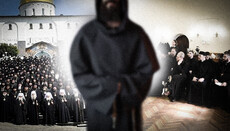
For comparison, in the UOC, despite the most difficult situation and unprecedented pressure, the number of monasteries exceeds 260, and the number of monastics is about 5000 people. This figure testifies to a living tradition and constant influx of new novices. Only during the first half of Great Lent 2026, more than 30 monastic tonsures were performed in the UOC. And this does not count tonsures into the schema.
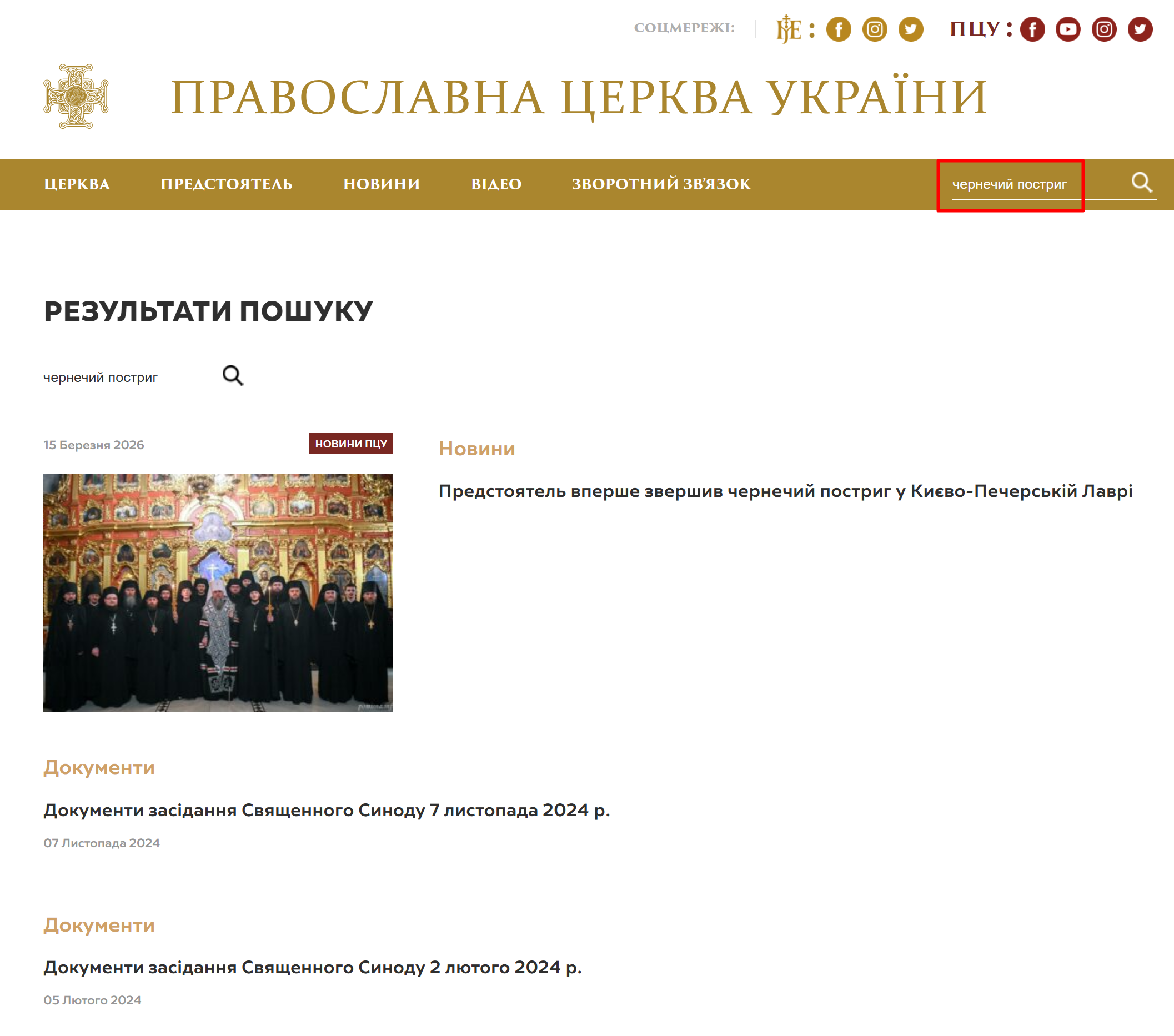
In the OCU, monastic tonsure is an extremely rare, almost exotic phenomenon. Searching for information about tonsures on official OCU resources yields isolated results for all years of the structure's existence. For example, if you enter "monastic tonsure" in the search bar on the OCU website, only one result appears – it will be discussed below. All other found variants are links to biographies of OCU "hierarchs" or canonized saints.
Priest Andriy Shymanovych, who was in the OCU for some time, in 2024 publicly noted that there are "serious problems" with monasticism in this structure: "When I say that there were no monastic tonsures in the Kyiv Orthodox Theological Academy for 5 years, this means that young people who graduate from seminaries and academies do not want to seriously connect their lives with this structure. This is not normal for the Orthodox Church, when monasticism is virtually absent. This is a problem, a big one."
The situation became even more evident after the transfer of the shrines of the Kyiv-Pechersk Lavra to the OCU.
In the "OCU Lavra," despite loud statements about creating a powerful spiritual center, only 6 people were listed for a long time. For comparison: in the Kyiv Pechersk Lavra of the UOC, about 200 residents lived in different years. Four years of attempts to attract new monks yielded no results – and this is not in a remote monastery but Ukraine's main shrine.
Another characteristic detail: the OCU loves to publish statistics of its structure: poll results, number of parishes, and even monasteries. But you will not find information about the number of monks anywhere on the resources of this structure.
Qualitative aspect: tonsures and reputational risks
The rarity of monastic tonsures in the OCU makes each such case a notable event, trumpeted by all media loyal to the structure. However, some of these tonsures attract public attention not through the spiritual feat of the newly tonsured, but through the scandalous trail following them. Essentially, in conditions of severe personnel shortage, OCU leadership turns a blind eye to candidates' moral character, just to replenish the ranks of "monastics."
"Tonsure" in the Kyiv-Pechersk Lavra (March 2026)
A resonant event of recent times was the "tonsure" performed in March 2026.
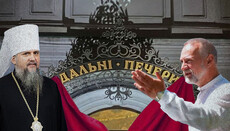
On March 15, shortly after the Ministry of Culture transferred the Near Caves and two churches of the Lower Lavra to the OCU, Epifaniy Dumenko performed monastic tonsure of two men in the cave church. They were theological academy students, Oleksandr Beskrovny and Maxim Palagnin, who received the names Barlaam and Spyridon in tonsure.
This event was widely covered by OCU resources as significant and historic – the first tonsure performed personally by Epifaniy at the Lavra. However, soon a loud scandal erupted in the information space, connected with one of the newly tonsured – Oleksandr Beskrovny (now "monk" Barlaam).
His intimate correspondence of a very specific character appeared on the Internet. Moreover, it was published by the most "patriotic" Telegram channels. For ethical reasons, we will not provide its details here. It is sufficient to say that its content is absolutely incompatible not only with monastic vows (primarily the vow of chastity), but also with basic norms of Christian morality.
The context of this story is important. Before his tonsure, Oleksandr Beskrovny, being in the rank of "priest," lived in St. Michael's Golden-Domed Monastery – the residence of Epifaniy Dumenko. It is hard to believe that the "primate" was unaware of the moral character and inclinations of the candidate for "monk."
In closed church structures, especially in the "primate's" residence, such things rarely remain secret. Perhaps Dumenko "tonsured" Beskrovny for this reason: awareness of others' weaknesses is a reliable guarantee of loyalty. And the second reason: Dumenko urgently needed to increase the number of "Lavra monks" to create the appearance of vigorous spiritual life in the seized shrine, so such "trifles" as personal life were not given importance.
This case raises legitimate questions: what criteria guide the OCU in selecting candidates for monks? If people with such reputation are "tonsured" in the Lavra – the heart of Ukrainian Orthodoxy – then what happens in provincial "monasteries"? Is this "tonsure" not an illustration of the state of the OCU, whose leadership turns a blind eye to glaring reputational and canonical costs?
Scandal with "hieromonk" Ioann Bondarev and Metropolitan Oleksandr (Drabinko)
The Beskrovny case in the Lavra is far from the first reputational "failure" connected with "monastic" personnel in the OCU. In December 2022, another loud scandal broke out, this time around the appointment of "hieromonk" Ioann (Alexei) Bondarev as abbot of a "transferred" church in the village of Rusaniv near Brovary.
Bondarev turned out to be one of the main figures in a loud media scandal with the publication of intimate non-traditional correspondence, in which, as Ukrainian media and Telegram channels claimed in February 2021, Metropolitan Drabinko was also involved. The correspondence contained unambiguous hints and discussions far from spiritual topics.
Later, screenshots of Bondarev's page on a non-traditional dating site were published online. On his page, he called himself "Reverend" and openly sought partners.
It would seem that after such public disclosure, the path to priesthood, and especially to monasticism, would be closed forever for this person. However, in reality, everything turned out differently. The loud scandal did not prevent Drabinko from ordaining Bondarev as deacon, then performing "monastic tonsure" over him and elevating him to the rank of "hieromonk." During 2022, "hieromonk" Ioann Bondarev was a cleric of the Transfiguration Cathedral in Teremky, Kyiv. And then, in December 2022, Drabinko appointed him abbot of the St. Nicholas Church in the village of Rusaniv, seized from the UOC.
Such a personnel policy causes, to put it mildly, bewilderment. Persons involved in public scandals incompatible with monastic vows not only do not bear canonical penalties but also receive "holy orders," "monastic tonsure" and abbotship in a church – and this deals a crushing blow to the OCU's authority. At the same time, the structure's leadership does not react even to obvious and documented facts. The conclusion suggests itself: canonical norms and the moral character of clerics are secondary for the OCU compared to personal loyalty or the need to fill vacant positions in seized churches.
It is important to note that damaged human nature is the same for everyone. And in the UOC, there may be people inclined to theft, adultery or violence. But in the Church, public exposure of sin does not remain without consequences. Just as violence against one's own brothers, expelling them from churches and homes, is not ignored, much less encouraged.
Analysis of causes and consequences of the monasticism crisis in the OCU
The presented facts and statistical data allow several conclusions about the state of "monasticism" in the OCU and the causes of this crisis.
1. Absence of continuity and living tradition. Monasticism cannot be created "from above" by administrative decree, Synod resolution or secular authorities' decision. Monasticism is a living tradition passed from experienced elders to young novices. It is a school of spiritual life formed over centuries. In the OCU this tradition is interrupted or initially absent. Most monasteries of this structure exist only as legal entities registered with the Ministry of Culture, but are not real centers of spiritual life. Where can new monks come from if they have no one to learn from?
2. Priority of form over content. In conditions of political necessity to demonstrate the presence of monastics (especially in the context of the struggle for the Kyiv Pechersk and Pochaev Lavras), OCU leadership apparently is ready to critically lower requirements for candidates. "Tonsures" are performed not for a person's spiritual growth, not for their salvation, but to create a beautiful television picture and fill vacant positions in the staff schedule. Monasticism becomes an instrument of political PR. It is appropriate to recall here that the situation with priests in the OCU is not much better. They are recruited through advertisements posted on poles, their "hierarchs" call for seeking candidates in villages, and during "ordination" some do not even know the Creed.
3. Ignoring canonical norms and vows. Monastic vows – obedience, non-possessiveness, chastity – are strict, lifelong and mandatory for fulfillment. Ordination and tonsure of persons openly and publicly violating these vows (particularly the vow of chastity) testifies to a deep crisis of canonical consciousness in the OCU structure.
If monastic tonsure is given to people with questionable reputation, then the very concept of monasticism in this organization is leveled and loses its sacred meaning.
4. Consequence – total distrust of believers. Personnel shortage in the OCU is not the cause of the crisis, but its logical outcome. Believers seeking genuine spiritual life, asceticism and monastic feat do not go to a structure where trampling canons and promoting persons with questionable morals becomes the norm. People understand very well where the Church is and where there is only a political project. That is why, despite colossal pressure from the state, harassment in media and seizures of churches, the number of monks in the persecuted UOC steadily grows, while in the state-favored OCU it stagnates or even decreases.
Theological and ecclesiological context
The problem of monasticism in the OCU has not only sociological but also theological dimension. The Holy Fathers of the Church always emphasized that monasticism is a barometer of the Church's spiritual life. Saint John Chrysostom said that monasteries are quiet harbors where people flee seeking salvation from the storms of the worldly sea.
If a church structure has no monasticism or it is represented by people far from ascetic ideals, this questions the ecclesiological completeness of such a structure. A Church deprived of monasticism loses its aspiration to the Kingdom of God, becoming simply a social institution for satisfying religious needs.
Attempts by OCU leadership to replace real monasticism with loud statements, media "tonsures" and seizures of ancient monasteries are doomed to failure from a spiritual standpoint. It is impossible to "appoint" a person to be an elder or saint. Spiritual authority is earned through years of repentance, prayer and tears, not by "synod" resolutions.
That is why monasteries without monks or with residents whose lives directly contradict vows given before the Cross and Gospel cannot become spiritual centers of attraction for believing people.
Until deep repentance occurs in the OCU, rethinking of the very foundations of monastic work and strict canonical discipline is restored, personnel shortage in this structure will only worsen. And attempts to artificially inflate the staff of "Lavra monks" at the expense of persons with questionable reputation will lead only to new scandals, finally discrediting the idea of monasticism in the eyes of Ukrainian society.