



Scandal in Lviv: why it is pointless for the UOC to prove its patriotism
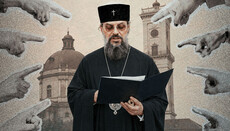
Metropolitan Filaret gave Lviv a building for a rehabilitation center for wounded soldiers. Yet “patriots” demanded an explanation as to why a UOC bishop was present at its opening.
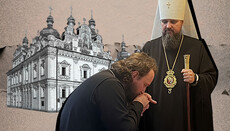
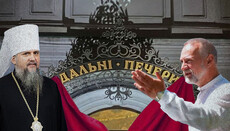
A scandal erupted in Lviv over the opening of the UNBROKEN rehabilitation center. The reason was the presence of Metropolitan Filaret (Kucherov) of Lviv and Halych at the event.
Representatives of the UGCC and OCU, as well as members of the patriotic public, sharply criticized Lviv Mayor Andriy Sadovyi for inviting a UOC hierarch to the event.
UGCC cleric Yustyn Boyko called what happened “a triumph of the Moscow Patriarchate in Lviv” and “a public attempt by the city mayor to personally rehabilitate it.” Boyko published several posts on Facebook, culminating in an open letter to Sadovyi. He called on the Security Service of Ukraine to investigate Lviv City Council, as the main organizer of the event, for “betrayal of Ukraine’s national interests.”
Nearly all politicians in Halychyna came out with harsh statements over the UOC hierarch’s presence at the opening of the medical center, while local media picked up the story. MP Sofia Fedyna called it “utter trash,” the European Solidarity party demanded an answer to the question, “Who is opening the door to the Moscow Patriarchate – and why?”, while Lviv City Council deputy Ihor Zinkevych called for an investigation into who had invited the UOC metropolitan to the event.
Veteran Roman Kravets staged a one-man picket outside Lviv City Council with a placard reading: “Down with the Moscow Patriarchate and Sadovyi.”
The wave of hostility was so intense that Sadovyi was forced to publish a comment on the situation that very same day. His statement was confused and unconvincing. According to him, he had not invited the hierarch, the metropolitan had not consecrated anything at the UNBROKEN opening, and overall “this is still a very bad story.”
Sadovyi’s explanation satisfied no one, and some hotheads are already demanding his resignation. But what actually happened?
What happened
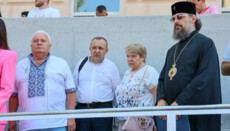
On August 6, 2026, a new building of the UNBROKEN rehabilitation center for wounded Ukrainian servicemen was opened in Lviv. The event was attended by Lviv Mayor Andriy Sadovyi, acting head of the Lviv Regional Council Yuriy Kholod, Deputy Head of the Lviv Regional Military Administration Khrystyna Zamula, city council deputies from various factions, the leadership of the First Medical Union of Lviv, and the mayor of Freiburg.
Metropolitan Filaret was present for one simple reason: in 2023, he transferred to the city the 3,500-square-meter building in which the medical center was opened. “In April 2023, by decision of the Holy Synod, the buildings of the former Resurrection Monastery, which were owned by the Lviv Eparchy, were transferred to the Lviv city community,” the hierarch wrote on Facebook. Thanks to benefactors from Taiwan, who invested €5 million in renovating and equipping the building, the medical center was able to open.
At the opening, Mayor Sadovyi described the situation as follows:
“It was 2023. The war was in an intense phase. The hospital was overcrowded. Vladyka Filaret came and said: ‘I am ready to transfer – to donate – an unused building to the hospital.’ The offer came as a pleasant shock, because people rarely give things away.”
Oleh Samchuk, director general of the First Medical Union of Lviv, said at the center’s opening: “This building was donated to the hospital by Vladyka Filaret – I want to emphasize that – and without him, none of this would have happened.”
Metropolitan Filaret’s own role at the event was to read aloud the 2023 act transferring the building to the hospital. And this is where certain questions arise.
April 2023: The final destruction of the eparchy
April 2023 marked the final destruction of the Lviv Eparchy of the UOC at the hands of the authorities, activists and OCU representatives. On April 5, St George Cathedral in Lviv was forcibly seized, and the following day the authorities demolished St Volodymyr Church with an excavator. At the same time, Lviv terminated its lease agreement with the Holy Trinity community. Thus, by April 7, not a single legal UOC parish remained in the city. Andriy Sadovyi commented at the time: “In these two days, we have brought the history of the Moscow Patriarchate in our city to an end.”
But what is especially interesting is that in his comments, the mayor also mentioned the very building where the medical center would open three years later. On April 4, 2023, he said: “The premises on Pekarska Street will be taken onto the city’s balance sheet. We will develop the rehabilitation system here. It is an important, ‘God-pleasing’ initiative, so I think no one will object.” Strangely, he made no mention whatsoever of any donation by Metropolitan Filaret. Then, on April 6, Sadovyi again spoke about the same property: “The premises on Pekarska Street have officially been transferred for use by the First Medical Union.”
Apparently, by then Sadovyi had already been informed of the “donation.” And most likely, the building would have been taken from the Church anyway – one way or another.
Nevertheless, voluntarily transferring it made the authorities’ task dramatically easier. And this brings us to the main point.
Help or don’t help – you are still the enemy
From the outside, the Lviv hierarch’s action looks like a model act of patriotism. The Church hands over a 3,500-square-meter building to the city free of charge – and not for some everyday municipal purpose, but for the treatment of wounded defenders of the country. It is difficult to imagine a gesture that the state and society should have appreciated more highly. Lviv society “appreciated” it with harassment and insults – and these were directed not even at the UOC hierarch himself, but at those who had allowed him to attend the medical center’s opening.
And this situation is a lesson for the entire UOC.
Today, after several years of unprecedented persecution of the Church, there are still bishops and priests who sincerely believe that the persecutors are simply mistaken. That if only they could be made to see that UOC members are just as patriotic toward their country, everything would change.
The example of Metropolitan Filaret clearly demonstrates that all such hopes are a profound delusion.
First, the Lviv hierarch stopped commemorating Patriarch Kirill even before the decision of the Feofaniya Council. His views on the future of the UOC are openly “pro-autocephaly”; he has consistently and publicly condemned the Russian invasion; and before the authorities dismantled the Lviv Eparchy, it regularly helped the army. What difference did any of this make? None.
Second, Metropolitan Filaret’s contacts with the city leadership led nowhere either. Taras Antoshevskyi, editor-in-chief of the Uniate outlet RISU, described the situation this way: “I was not surprised that Metropolitan Filaret appeared in Lviv. He has both property and supporters. He may continue to appear in public. Because he was not persona non grata in officials’ offices and was not alien to many of them.”
In other words, the hierarch tried to establish relations with the authorities, but the moment the “public” raised its hysterical voice in Lviv, officials immediately distanced themselves from him.
If we recall Andriy Sadovyi’s words of gratitude to Metropolitan Filaret at the opening of the medical center, it is clear that he was prepared for the hierarch’s presence at the event. And even if the Lviv mayor did not personally invite him, everyone understands that the presence of a UOC bishop would have been impossible without his approval. Yet just a few hours later, after the scandal erupted in the media, Sadovyi was saying something entirely different: “No, I did not invite him. No, I did not approve the guest list, because everyone here has their own responsibility and their own vision. There really was a screw-up here.”
And when speaking about the building on Pekarska Street, the mayor said not a word about the eparchy’s donation: “After the start of the full-scale war, it was returned to the Lviv community. Calmly, without conflicts and years of litigation. Yes. That happens too.” In other words, according to Sadovyi’s version, the building somehow passed into city ownership “by itself.”
This is a very clear lesson for all bishops and priests who still count on their connections with the authorities. That calculation is mistaken and naive.
You can negotiate, you can donate buildings, you can provide humanitarian aid to the city, send vehicles to the front and do all the rest. But if someone decides to unleash a wave of hatred against a “Moscow priest,” all of it will instantly count for nothing.
And here we need to explain why this happens. The large-scale anti-Church rhetoric we have witnessed in Ukraine in recent years has turned UOC clergy and faithful into a caste of people stripped of virtually all rights.
This was expressed most vividly by OCU cleric Serhiy Yanchuk as he personally cut the locks off a UOC church in the village of Cherniavka, Zhytomyr Region. “What rights do you have here?” he told the rector of the church. “You are an enemy of the people. I wouldn’t even shake your hand.”
This is most evident precisely in Halychyna, whose center local residents regard as the cultural capital of Ukraine. Not a single legal UOC community remains there. The faithful gather secretly for Liturgies in “safe-house” apartments, looking over their shoulders to make sure no “patriots” are watching them. And these are not excessive precautions. Journalists and “activists” hunt down such communities. And when they find them, “corrective” measures follow – such as throwing brilliant green antiseptic in priests’ faces.
What conclusions can be drawn from all this?
Very simple ones. For UOC clergy and faithful, trying to prove their love for their homeland to society is utterly pointless. You may do ten times more for your country than the most zealous “patriots,” and it will change nothing. Massive propaganda has brought things to the point where the very fact of belonging to the Ukrainian Orthodox Church has become synonymous with membership in a caste of “outcasts.”
From the standpoint of ordinary human relations, of course, this is deeply unjust. But once we open the Gospel, everything changes completely. Christ speaks very clearly about this “outcast” status: “If the world hates you... you are not of the world, but I chose you out of the world, therefore the world hates you” (John 15:18–19).
And the final Beatitude makes it even clearer: “Blessed are you when they revile and persecute you, and say all kinds of evil against you falsely for My sake. Rejoice and be exceedingly glad, for great is your reward in heaven, for so they persecuted the prophets who were before you” (Matt. 5:11–12).
For many years, we understood these words in the abstract, as referring to the persecutions of the first centuries of Christianity or the Soviet era. But today they are addressed directly to us. That is why we must not lose heart, and we must not be indignant. Our reward is not here and not now.