
Self-defense techniques from Saint John Chrysostom
For nearly five years now, Ukrainians have lived in constant fear. After nighttime attacks, we are afraid to open the news, expecting reports of tragedy. Men recoil from uniformed officers in the streets, fearing they may run into a military enlistment patrol. All of us fear the sudden loss of a way of life that, though precarious, has at least become familiar.
When a UOC community is deprived of the only church in its village, and a husband or son may at any moment be seized by enlistment officers and sent into the meat grinder at the front, a sense of utter defenselessness becomes a constant companion. It feels as though a vast machinery of repression could crush us, erase our human dignity, and take away everything precious – even life itself.
In search of spiritual support, we often look for easy consolation. But the worn-out phrase that we simply have to endure no longer works – it sounds sugary and false.
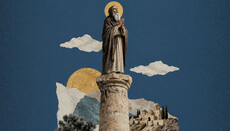
To find invisible armor, let us travel in our minds to the village of Cucusus during the snowy winter of 406. There, in remote exile, a gravely ill elderly man suffers in a worn cassock, a panagia resting on his chest. Behind him lie expulsion from the imperial see, betrayal by friends, and public humiliation. Wild Isaurian raiders roam around his humble shelter, while in the distant capital his followers are thrown into prison cells and tortured.
From this place of torment, St. John Chrysostom writes a sobering manifesto, setting out a rigorous theorem of spiritual self-defense. We enter his cold dwelling to ask him the painful questions of our own time.
Recognizing what belongs to someone else
– Your Eminence, how can we remain sane when church life is being destroyed around us? Our brothers are deprived of their churches, expelled from holy places, and stripped of property accumulated over many years. It seems that we have suffered total defeat and been left destitute.
St. John looks us directly in the eyes and answers without the slightest hesitation:
– Has the man whose possessions were taken through the schemes of slanderers truly suffered harm by losing everything? No, he has not. He may even have benefited, provided that he remains attentive to himself.
Then he asks:
– What have they taken from you, man? Money? But it is not your property. If you think otherwise, you harm yourself by becoming attached to what belongs to another. All of it belongs to the Lord, while you are only its temporary steward.
To deprive a person of something is simply to lighten his burden on a difficult journey.
We fall silent before this paradoxical reasoning: the holy father instantly dismantles our familiar system of values. We are accustomed to regarding earthly comfort and social standing as our inalienable possessions – and so their loss feels like a mortal wound.
But viewed through the lens of the Gospel, our relationship with the world looks very different. Everything external turns out to be little more than old furniture in a rented apartment. Raiders may confiscate money, seize the keys to a church, or freeze bank accounts, yet all of this remains outside us. Our true treasure – faithfulness to Christ, purity of conscience, and inner peace – is kept in an inviolable vault to which our enemies have no access. They can only beat their fists against empty air unless we ourselves open the door of our hearts to them.
The limits of their power
– Your Eminence, the state is now taking away more than property. People are afraid of losing their freedom. We fear violence. We fear being dragged into a van, locked in a cell, or sent to the front line, where death may be inevitable. How can we keep from losing our minds from fear?
St. John answers firmly and clearly, for he himself endured a succession of arrests:
– Have you been driven beyond the borders of your homeland? Consider that you have no homeland here. Indeed, if you wish to live wisely, you have been commanded to regard the whole earth as foreign to you. Have you been condemned to death? Remember that death is a debt owed to nature, which every one of us must eventually pay. If you are killed for the sake of truth, they will merely hasten your meeting with the Heavenly Father.
Then, after a brief pause, he adds the crucial words:
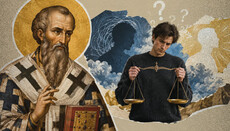
No one can harm a person unless that person first harms himself.
These words strike like shock therapy. The saint strips us of every illusion. Those who seek to pressure us through laws, threats, or weapons imagine themselves to be the sole directors of our destiny – and it truly seems to us that they have complete control over our lives.
But from the perspective of eternity, the powerful of this world resemble stagehands. They can move the scenery, replacing a comfortable room with a damp trench or a prison cell. But they are powerless to write the script of our soul. They cannot force a person to hate, betray, or curse.
The only way to inflict spiritual harm on someone is to make him surrender his spiritual ground. If, under the pressure of circumstances, we turn into embittered beasts, fall into despair, or betray our faith and our Church, then we ourselves hand the hostile world a warrant authorizing the destruction of our own hearts.
Who alone holds the keys to the soul?
– St. John, your theorem sounds almost incredible. Does this mean that in the whole vast universe there is only one person capable of ruining our life – ourselves?
The universal teacher narrows his eyes and smiles with gentle calm:
– Do you see that the person who does not harm himself suffers no true evil, even if everyone insults him? Neither a demon nor the devil himself can destroy us unless we first harm ourselves. The only real evil on earth is sin, because only sin separates a person from God. Everything else is merely shadow and cloud, dispersed by the light of the sun.
Our conversation with St. John Chrysostom leaves us with an astonishing sense of restored human dignity.
We leave his cell as different people. Fear of repression gives way to collected vigilance. At last, we understand that all the threats of the modern world can strike only the outer shell of a person. No official, judge, police officer, or armed enlistment squad has authority over our conscience unless we ourselves hand them the keys to its door.
As we part, the saint gives us final guidance on how to live through any upheaval:
– Guard your soul against malice and despair. If the house of your heart is clean, no storm outside can shake it from its foundation. Glory to God for all things!