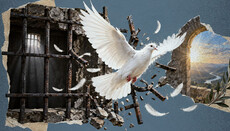

An air raid alert will never interrupt a divine service
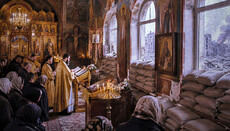
At times when an air raid alert catches us in the middle of prayer, the first feeling is not fear at all, but frustration., strange as it may seem. It feels as though we did not deserve to spend that evening on a cold stairwell or in an underground car park, where a neighbor nervously shuffles in his slippers and his dog whimpers desperately and barks frantically after a passing missile. Another prayer rule has been cut short halfway through. A person is tormented by a guilty conscience: what if all of spiritual life came to an end along with the outbreak of this terrible war?
Out of annoyance, we grow angry like a craftsman who has had his tools taken away and been made to work with bare hands. For years we have been carefully constructing a theology of comfort, in which a prayerful encounter with God requires a corner with icons, time free from family routine, and silence for reading spiritual literature. But when those props collapsed overnight, it suddenly became clear that we do not really know how to pray properly at all, even though we consider ourselves seasoned Orthodox Christians.
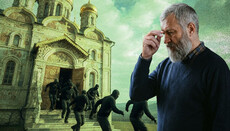
Saint John Chrysostom said plainly: “Nothing prevents us from praying even when we are away from home... let us not seek a special place for prayer. Wherever we may be, we can make a temple for ourselves. For where the mind and thought are concentrated on God, there is the altar, there is the sacrifice, there is the sacred rite.” This was said to Christians who still remembered what a sudden pagan raid looked like.
God who wandered with His people
Let us go back to the distant past – to the Judean wilderness, where dangers awaited the traveler at every step.
When the Lord first established His dwelling among men, He chose not a well-appointed palace but the Tabernacle – a portable tent made of skins and coverings. God refused to be confined to one place. He set out with His people into the unknown, through the sands, the thirst, and the raids of enemies.
The Church in Ukraine has also become such a Tabernacle. It has left behind its firm foundations and gone down into damp basements, underground stations, and concrete passageways. And God descended there with it, not scorning the fact that, instead of a marble throne, He was offered only a cracked wooden bench by a heating pipe.
It should be said that early Christians knew nothing of peaceful, undisturbed worship.
They celebrated the Eucharist in private homes and underground galleries, listening with half an ear to whether the guards were coming down the street. An All-Night Vigil held in an atmosphere of fear is the very apostolic antiquity we longed for during the years of prosperity and security.
The circle closed again in the last century. At Solovki, if the camp memoirs are to be believed, services were held in the forest, with an ordinary tree stump covered with a cloth to serve as an altar, and cranberry juice was poured into the Chalice instead of wine for the simple reason that cranberries grew in the surrounding marshes, while grapes could not take root there.
And no theologian would dare say that those Liturgies were less prayerful than ours: with a festive choir, beautiful vestments, and bright electric chandeliers.
The forgotten domestic service
A practical question arises for our anxious times: what should one do if, on a Sunday, one cannot reach the church – neither on foot nor by transport? If the road is under fire, if public transportation is not running because the infrastructure has been destroyed, or, ultimately, if one is simply ill and unable to attend the Liturgy?
The liturgical books have long provided for such a case with the Obednitsa, or the Typika service. It does not replace the Liturgy and does not offer the possibility of receiving Communion, but it allows a layperson to read what he hears in church: psalms, the Beatitudes, the Creed, the Our Father, and the appointed readings from the Epistle and the Gospel.
Our ancestors held firmly to this service because the only open church was often half a day’s journey away, and sometimes even more than a hundred kilometers distant. Later, believers forgot about the Obednitsa simply because they no longer needed it. Now the realities of wartime compel us to remember this service and to include it in our prayer practice.
Prayer at the epicenter of fear
There are now frequent moments in our lives when the buzzing of a drone or the roar of a missile is heard above the roof and only a few seconds remain before impact. A prayer book is useless at such a moment, because one's hands are trembling and the right page cannot be found. All that remains is “Lord, have mercy” and the Jesus Prayer, spoken in rhythm with one's breathing.
The Venerable Paisios the Athonite said: "A prayer offered with heartfelt pain goes straight to God... A single ‘Lord, have mercy,’ spoken in a moment of danger, is equal in worth to hours of prayer in a calm state."
Our prayer rule of peacetime – canons, akathists, psalms – is like a course of treatment at a sanatorium where we receive massages and are offered mineral water. Under shelling, something like clinical death sets in, when what is needed are short, powerful shocks to a heart that has stopped from terror: Lord-Jesus-Christ-have-mercy-on-me. And from those shocks the heart finally starts again.
Yes, prayer does not function like an air defense system. A missile flies along its trajectory and strikes where it was aimed. We ask God for protection, entrusting our lives to Him entirely.
It is important to understand: even in moments of mortal danger, a believer must remain a Christian, not surrendering to the power of animal fear.
Archimandrite Lazarus (Abashidze) taught: "If we do not know how to pray amid hustle and bustle, we will not learn to pray in silence either ... It is created within us when we stand before the presence of God.” Silence is not a condition of prayer but its result.
We now understand that an air raid siren cannot interrupt prayer. It only changes its register, shifting our worship from major to minor, from splendor to confinement, but in that shift its essence is not lost. All outward beauty fades sooner or later, while the One to Whom we turn in prayer will never disappear.