
The defiant daughter of a pagan priest
As one ascends the mountain along the road from Yalvaç, a flat field comes into view, along with a semicircular retaining wall with a staircase and the remains of a portico. This is where the Temple of Emperor Augustus once stood. The city itself was called Caesarea. It was a Roman colony on the border of Phrygia, spread across several hills. The city had an aqueduct, a theater, and a main street that ended at this very staircase.
Two and a half centuries before that, the Apostle Paul passed through these lands. In the local synagogue, he preached on the Sabbath. By the end of the third century, a fifteen-year-old girl named Marina was tried here. What crime could such a helpless maiden have committed?
The "bare minimum" that could not be refused
Roman authority was indifferent to a person's spiritual convictions. Far more important to it was the outward expression of religiosity. Ritual decided everything. The gods were honored simply because that was the custom. For insulting them, as the Roman saying went, "the gods take vengeance themselves."
This gave rise to a favorable deal. A Christian at that time was accused not of atheism but of sacrilege – failing to render to the state deity what the law required. It was impossible to refute such an accusation with words alone; a concrete act was demanded – a sacrifice. The options included a pinch of incense placed on a brazier, an oath sworn in the name of the gods, or a drop of wine poured before the emperor’s statue. Taking the accused person’s circumstances into account, the judge would offer the cheapest way to fulfill the obligation, sincerely unable to understand why Christians were so stubbornly refusing.
The statesmen of Rome, who themselves took religion lightly, did not see in Christianity a sincere choice of conscience. They did not believe that they were asking Christians to do anything unacceptable; rather, they believed they were demanding only the “bare minimum.”
A person who refused to perform such an easy duty appeared to onlookers as a madman, risking his life over trifles.
The empire's verdict for Christians was categorical: "You have no right to exist in this land." Yet it was not delivered as an ultimatum, but in the form of an outwardly lawful judicial process. Until the very last moment, officials left each defendant a narrow loophole for salvation. Consent to the sacrifice – and you would be acquitted at once.
The fateful proposal of Olybrius
The father of the accused girl named Aedesius served as a priest at a pagan temple. Her mother died while the girl was still in swaddling clothes. Her father gave her to a wet nurse in a village. There, at the age of twelve, she heard a passerby speak of Christ and believed at once despite the fact that persecutions were in full force at the time, and priests were hiding in caves and villages disguised as beggars. There was no one even to baptize the new convert. And so she remained unbaptized until the last day of her short life.
When Aedesius learned of his daughter's faith, he disowned her. One day Marina went out to the field to tend her father's sheep. At that moment, the eparch Olybrius was passing by on his way to Antioch. He stopped and began to inquire about the girl's origins, reasoning thus: "If she is freeborn, I will take her as my wife; if she is a slave, I will buy her freedom." The girl answered him calmly, making no secret of the fact that she was a servant of Christ, and that she needed no other bridegroom.
It is clear that such a confession was followed by an immediate trial. There, Marina was offered generous rewards three times. First, she was promised wealth, property, and honor greater than that of any woman in the city. Then she was offered the hand of the ruler himself. When the judges realized that their kindness had no effect, Marina was told that she would have to exchange her youth and health for fire and iron. The girl remained unyielding.
She was beaten with rods, then nailed to a board and scraped with iron tridents, so that even the enamored eparch covered his face and turned away. Then her body was burned with lit candles. The people pitied the girl and urged her to yield, but the saint answered them sharply: "You are counseling me the same thing the serpent counseled Eve."
The hammer in the saint's hands
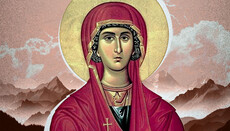
In Greek iconography, the great martyr Marina is depicted with a hammer in her hands. The saint holds a heavy blacksmith's hammer and strikes a demon on the head with it. Yet in the life of the saint as set forth by Saint Dimitri of Rostov, there is no hammer. The account reads differently.
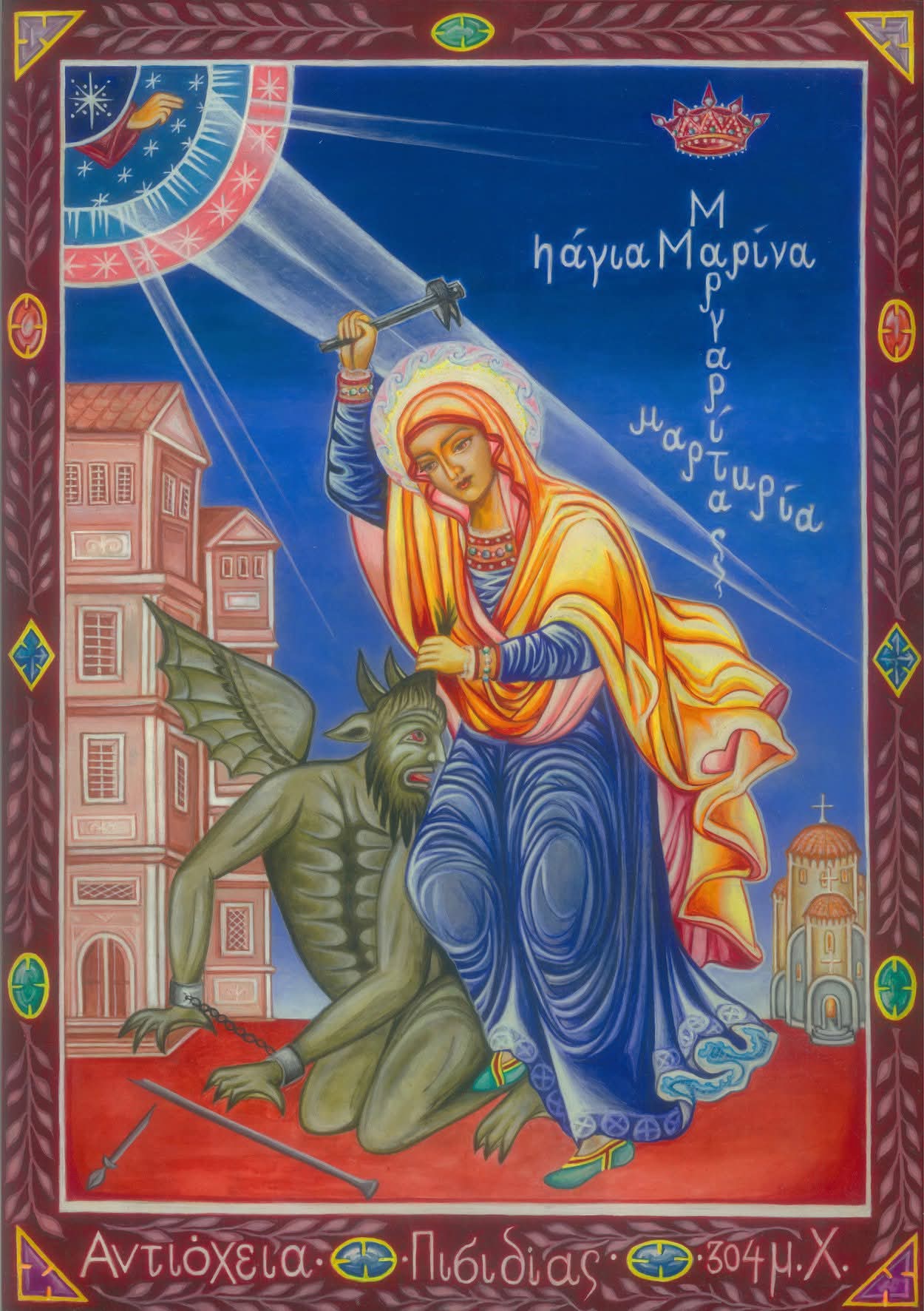
In the deep and gloomy dungeon where those condemned to death were imprisoned, the martyr was confronted by a terrifying demonic apparition in the form of a gigantic serpent that seemed to swallow her whole. The saint made the sign of the cross over herself; the serpent’s belly split open, and the illusion vanished. The Greek tradition continues the story: the demon, having lost its dragon-like form, turned into a black dog. It was then that the girl took up a hammer.
There is no need to argue over the different recensions of the Life. Besides, the hammer in the hands of Saint Marina may also be understood symbolically. It is an effective tool because it strikes the same point again and again.
The saint's will did not waver from the first interrogation to the last moment of her life. Having passed through fire, she asked God to grant her the water of holy Baptism.
The judge caught only the word "water" and ordered, “If she is thirsty, give her water to drink.” But the torturers brought in a great barrel instead. They bound the martyr and attempted to drown her.
During the execution, Marina prayed that this water might become her Baptism into eternal life. She emerged from the barrel alive. Many people who witnessed the miracle openly called themselves Christians for the first time. But the executioners did not stop there. That same day the saint was beheaded by the sword. And so the water in which they had intended to kill her truly became the baptismal font for the martyr who had not been tempted by the privileges of the state but remained faithful to Christ until her last breath.