
Icons under the axe: How an empire decided to ban the visible God
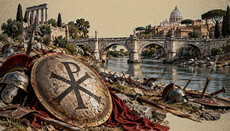
Church history is full of paradoxes, but one stands apart. The most powerful answer to the full might of the Byzantine Empire was written by a man the empire could not reach – a monk living under Muslim rule. Constantinople was smashing icons, while from distant Damascus there came texts whose every paragraph struck with greater precision than any imperial decree. But to understand why those texts proved stronger than an army, one must first understand what exactly the empire was fighting – and why.
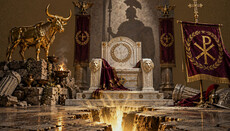
The invisible God, convenient for the bureaucrat
The logic of the iconoclasts sounded almost flawless. God is great, incomprehensible, not containable in a wooden panel, not reducible to paint and gold. It is dangerous for man to cling to what is visible – he begins bowing to the board instead of to the One who stands above all matter. The scheme looked neat, almost lofty.
But such schemes always have one advantage: they are far too convenient for power.
The invisible God has no need of a monastery with archives, land, and pilgrims. The invisible God does not challenge an imperial decree. He is easily turned into a useful abstraction – and then used in His own name to govern men. The language of “purity of faith” concealed a very different agenda: to turn religion into an obedient instrument. To leave Christ as an idea, rather than as the One who truly entered human flesh.
And there was one more detail. In a church where, high above, the face of Christ Pantocrator shines forth, any earthly ruler ceases to look like the center of the universe and appears instead for what he is – a temporary steward. He is being looked down upon from above. Emperor Leo III the Isaurian did not care for that.
Why the empire needed monastic lands
In Byzantium, monasteries were not ornaments of the landscape. They were independent forces in their own right, possessing land, income, libraries, and shelters. They were exempt from taxation, and monks were exempt from military service. For an empire accustomed to seeing itself as the source of every decision, such an island of independence was an irritation.
The scale of the assault became fully apparent under Leo’s son, Emperor Constantine V, whom Orthodox tradition remembered by the nickname Copronymus. It was he who turned iconoclasm from a theological dispute into a full-scale war on monasticism. After the Council of Hieria in 754 condemned the veneration of icons, what followed was what historian Peter Brown aptly called “iconoclasm in action – a war against monks.” Monasteries were confiscated and turned into barracks. Monks were driven into the hippodrome and forced to hold women by the hand in mockery of their vows. Michael Lachanodrakon, strategos of the Thracesian theme, burned the Monastery of Pelekete on Mount Olympus. Venerable Stephen the New, who refused to submit, was torn to pieces by a mob in Constantinople in 765. Silver coverings were melted down into coin. Thousands of monks fled to southern Italy and Sicily.
On the surface, this was a struggle for “pure spirit.” In reality, it was the clearing away of the only institution capable of existing outside the direct control of the palace. A familiar situation, is it not?
The bronze gate and the first blood
The canonical version of the beginning of iconoclasm is well known: imperial soldiers set ladders against the Bronze Gate of the palace – the famous Chalke – and began knocking down the mosaic image of Christ. Not debating with the clergy, but literally knocking it down. Defenders of the icon rushed at the soldiers; according to later tradition, the nun Theodosia overturned the ladder, killing one of the men carrying out the order. The clash began. Blood was spilled.
A qualification is needed here. Modern scholarship casts doubt on the canonical date of 726; a number of researchers believe the formal beginning of iconoclasm should be dated to 730, when Leo III forced Patriarch Germanus to resign and issued an official edict. The event at the Chalke itself is described in sources written much later, and its details were probably embellished by iconophile writers. We do not know exactly how it happened.
But one thing is beyond doubt: the state that proclaimed itself a “purifier” shed blood first.
A Christian emperor ordered the face of Christ to be erased from above the entrance to his own palace.
The pen against the empire: a monk from Damascus
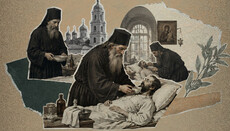
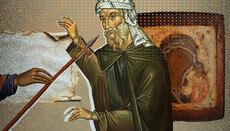
And here the stage is entered by a man the empire could not touch. Yuhanna ibn Mansur ibn Sarjun – a hereditary official from a Christian family that served the caliphate – withdrew to the Monastery of Mar Saba near Jerusalem and became the man we know as Venerable John of Damascus. His father, Sarjun ibn Mansur, headed the fiscal administration of Syria under five Umayyad caliphs, and John himself, according to a number of testimonies, held a high post at court before taking monastic vows.
The secret police of Constantinople could break patriarchs within the empire, but it could not reach a monk living on the territory of the Arab Caliphate. Venerable John wrote his Three Treatises on the Divine Images between 726 and 730, just as the iconoclastic machine was gathering momentum. It was theological weaponry of such force that the entire imperial construction suddenly began to look not like reform, but like a veiled denial of the Incarnation.
The saint’s central argument is as simple as it is devastating: formerly, when God was bodiless and invisible, He was not depicted. But once He appeared in the flesh and lived among men, we depict the visible God. To reject the icon, in John’s logic, is to refuse to acknowledge that the Incarnation was real.
And on matter itself the holy father spoke even more sharply: “I do not worship matter, but I worship the Creator of matter, Who became matter for my sake, and deigned to dwell in matter, and through matter accomplished my salvation.” If Christ became flesh, then wood, paint, stone, the human face – all of this can become a vessel of the memory of the Incarnation. To ban the icon is to attempt once more to turn the Son of God into a bodiless shadow. And that is no longer zeal for purity, but Docetism – albeit wrapped in the garments of the state.
The argumentation of Venerable John was fully received by the Seventh Ecumenical Council in Nicaea in 787. The empire that had warred against icons for more than half a century lost – though the convulsions of iconoclasm continued until 843, when the Triumph of Orthodoxy was finally proclaimed.
And this is what is most striking in the whole story. The entire military and administrative might of Byzantium – decrees, councils, confiscations, tortures, melted silver – proved powerless before the pen of a monk in a dusty cell beyond the empire’s borders. Because the empire was not really fighting boards and pigments. It was fighting for the boundaries of its own power. And no imperial decree can wash that fact away.