
The Pilate stone: How a piece of construction rubble silenced the skeptics
The coast of Israel, June 1961. The ruins of Caesarea Maritima. For the second summer in a row, Italian archaeologists were excavating the ancient theater. Beneath the scorching sun, they peeled back hardened layers of soil, catalogued broken fragments, and described stone after stone.
It was heavy, monotonous work, the kind in which miracles are rare. And yet it is often on such ordinary, unremarkable days that discoveries are made which overturn everything we thought we knew about the past.
One of the workers wedged an iron bar beneath a worn stone step and, straining with effort, pried it loose. The slab was turned over, the centuries-old dust brushed away – and suddenly, on the side that had long been hidden from the light, deeply carved Latin letters began to emerge.
The head of the expedition, Antonio Frova, bent over the find. In the slanting rays of the sun, the stern, chiselled script of empire could be read clearly:
...TIUS PILATUS.
A broken name on stone
Before the stunned scholars lay a heavy block of limestone. Long ago, builders had simply hacked off its left side to make it fit the dimensions of a staircase. Because of that crude act, only fragments of the Roman governor’s title and name survived.
Carefully, scholars reconstructed the inscription. Without the missing pieces, this broken Latin text translates very simply:
“...Tiberieum... Pontius Pilate... Prefect of Judea... made and dedicated [this].”
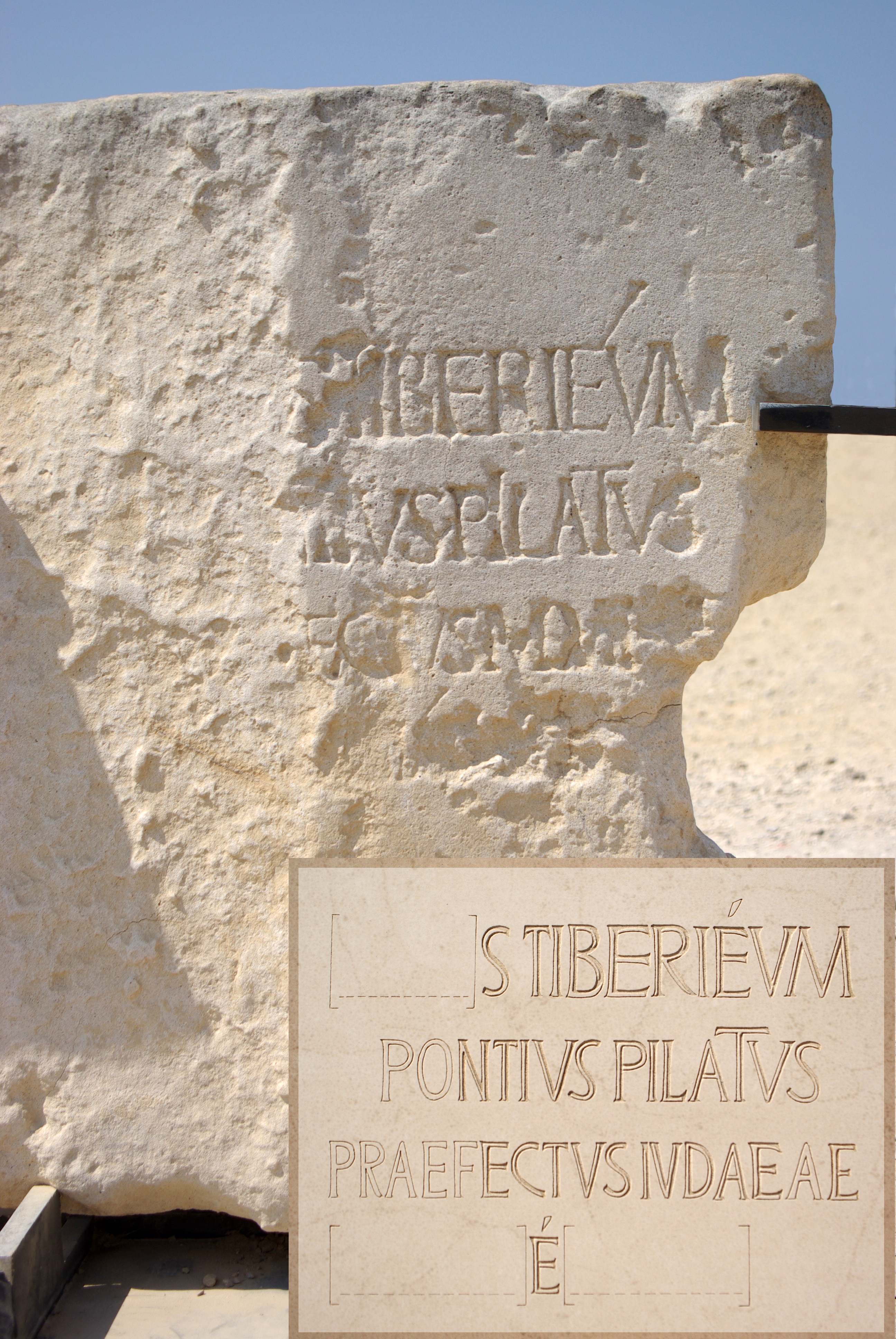
The name of Emperor Tiberius is engraved in noticeably larger letters than that of Pilate. In the Roman Empire, that was how one showed who the true ruler was – and who was only a temporary appointee.
Thrown on the scrap heap
Originally, this stone slab had adorned the façade of the “Tiberieum,” a large building Pilate constructed in Caesarea in honor of his Caesar. But worldly glory does not last. In the year 36, the governor’s career collapsed. Pilate had crushed a Samaritan uprising on Mount Gerizim with excessive brutality, shedding much blood. A Roman superior removed him from office and sent him to the capital to stand trial.
After that, Pilate vanishes from history. The building he had erected soon lost all importance. Several centuries later, it was simply dismantled for building material.
The memorial stone bearing the once all-powerful prefect’s name was ripped from the wall and thrown onto a common rubbish heap.
New builders laid it into the staircase of a local theater, face down. And that humiliation, paradoxically, saved the inscription. The front side was pressed tightly into damp earth, and generations of careless spectators were unable to wear it away with their sandals. Oblivion preserved what was supposed to disappear.
A stone more precise than the historians
This discovery proved priceless not only because it bore Pilate’s name. The stone identifies his office with exact clarity: Prefect of Judea.
It was prefects whom Rome sent to restless provinces – harsh governors in whose hands both military and judicial power were concentrated. But the famous Roman historian Tacitus, when describing Christ’s execution, called Pilate something else: a procurator.
Tacitus wrote his great work long after the Gospel events. By then, Roman governors had already begun to be called procurators, and the historian simply used the term familiar in his own day.
But this chipped and weathered stone, carved during Pilate’s own lifetime, preserved the truth of the age itself.
That ancient step turned out to be more precise than the Roman chronicles. It is striking, too, that the Evangelists themselves did not bother chasing after exact Latin titles. They simply called Pilate “the governor” – and for ordinary people, that was far clearer than the tangled language of imperial bureaucracy.
The silence of the archives broken at last
The Caesarea stone dealt a serious blow to critics of the Church. Before that summer day, many atheists confidently insisted that Pilate was a myth. Why? Because, they said, there was not a single line about him in Roman documents.
The vast bureaucratic machinery of Rome meticulously recorded taxes, correspondence, and official appointments, yet Pilate seemed not to exist at all. From that archival silence, they drew a blunt conclusion: if there are no documents, then the Gospel story must be fiction from beginning to end.
And then this limestone step shattered all their carefully built theories.
To this day, it remains the only indisputable archaeological artifact bearing the name of the man who condemned Christ to crucifixion.
Arguing with the stone proved futile, and the skeptics were forced into silence, compelled to acknowledge the historical truth preserved in the Gospel.
A mute witness
Of course, archaeology did not answer every question. Scholars still debate what exactly Pilate dedicated to the emperor – a pagan temple, a harbor lighthouse, or perhaps simply an elegant colonnade along the seafront. The stone says nothing.
Today, the original slab is carefully preserved in the Israel Museum in Jerusalem, while in Caesarea itself, under the unceasing sound of the sea, an exact replica has been set in place.
There is something deeply striking in the way the Lord governs human history. The most important witness to the earthly days of the Savior was not found in the guarded repositories of Rome. Paper archives burned long ago; imperial records crumbled into dust. What survived was a plain piece of stone – something once cast aside with contempt, thrown onto a rubbish heap, and built into a staircase.
There is a quiet and profound truth in that. The ancient stone proves nothing with shouting or fury. It simply exists. And across the span of centuries, it reminds us of a Gospel truth: what men cast beneath their feet in contempt may, in the end, become the most powerful witness of all.