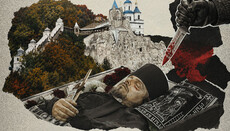

"Spiritual strength" built on blood: The truth about the Ukrainian Pantheon
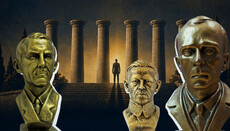
Ukraine’s Main Intelligence Directorate has begun speaking in language that is almost religious. In a statement marking the 145th anniversary of Symon Petliura, the agency declared that Petliura, Andriy Melnyk, Yevhen Konovalets, and “all national heroes buried abroad” should rest in Ukrainian soil, while the Pantheon should become a “place of spiritual strength for the Ukrainian nation.”
It is worth noting that this language of “spiritual strength” is coming not from church leaders but from military intelligence. Should this be understood to mean that spirituality in Ukraine is being removed from the religious and moral sphere and transferred to the state and its security structures?
Of course, Ukraine needs spiritual strength. But what kind of spirituality is being proposed? Let us take a closer look.
The Pantheon as a new state shrine
On May 19, 2026, President Zelensky announced the reburial of Andriy Melnyk, one of the leaders of the Organization of Ukrainian Nationalists (OUN). At the same time, officials stated that preparations were underway for the reburial of Yevhen Konovalets and other historical figures.
Just days later, on May 25, Zelensky took part in Melnyk’s reburial ceremony at the National Military Memorial Cemetery. He said this was only the first step and that Ukrainians of previous generations should rest alongside the heroes of the current war. Media reports indicated that work was underway regarding several hundred historical figures, including Stepan Bandera.
In essence, the authorities are building more than a memorial. They are creating a new state shrine. The Pantheon is intended to become a place where political memory acquires an almost sacred status. Those buried there will serve not merely as historical figures but as markers of identity around which a vision of the “proper” Ukrainian, the “proper” history, and the “proper” spirituality is formed.
Who is supposed to radiate this “spiritual strength”?
Let us begin with Melnyk. After the assassination of Konovalets, he became head of the Melnyk faction of the OUN. In 1941, Melnykite units entered Ukraine alongside the Wehrmacht and participated in forming the Ukrainian Auxiliary Police, which carried out repressive actions against civilians and persecuted Jews.
The reaction was immediate. Israel and Yad Vashem sharply condemned Melnyk’s reburial. Yad Vashem emphasized that honoring the leader of a movement that collaborated with Nazi Germany during the Holocaust undermines the moral foundations of Holocaust remembrance itself.
The case of Stepan Bandera is even more controversial. The U.S. Holocaust Memorial Museum notes that Ukrainian nationalist activists participated alongside German forces in the 1941 Lviv pogrom, in which thousands of Jews were killed. Historians continue to debate Bandera’s personal responsibility, as he was imprisoned by the Germans from July 1941 until September 1944. However, few dispute that his faction of the OUN and the UPA were involved in the Volhynian massacres, which claimed the lives of tens of thousands of Poles.
It was in this context that Zelensky signed Decree No. 440/2026 on May 26, granting a Special Operations Forces unit the honorary title “Named after the Heroes of the UPA,” citing the need to restore the historical traditions of the national military.
The reaction in Poland was predictable. Former Prime Minister Leszek Miller described the move as “an open spit in the face of every Pole” whose family suffered during the Volhynian massacres. President-elect Karol Nawrocki called for Zelensky to be stripped of Poland’s Order of the White Eagle. Former President and Nobel Peace Prize laureate Lech Wałęsa wrote on Facebook: “By honoring the bandits of the UPA, the President of Ukraine has insulted me and all our murdered compatriots,” and publicly removed a Ukrainian flag he had been wearing.
Symon Petliura, who is also expected to be reburied, likewise does not appear to be an obvious moral – let alone spiritual – authority. The Encyclopedia of Ukraine notes that his name is inseparably linked to the pogroms of 1918–1921. As the effective head of both the military and government of the Ukrainian People’s Republic, he bears political responsibility for those events. Various estimates place the death toll between 50,000 and 125,000, with hundreds of thousands more affected. In 1926, Petliura was assassinated in Paris by Sholom Schwartzbard, who said he was avenging the pogrom victims. A French court acquitted Schwartzbard, a verdict many interpreted as a moral judgment on Petliura as well.
Hatred as a virtue
Perhaps these tragedies were merely unfortunate byproducts of an otherwise noble movement?
The documents suggest otherwise.
The Decalogue of the Ukrainian Nationalist states: “You will meet the enemies of your Nation with hatred and ruthless struggle.”
Dmytro Dontsov, the chief ideologue of integral Ukrainian nationalism, wrote plainly: “Nothing in history has ever been created without violence and iron ruthlessness.”
These were not accidental excesses. They were foundational texts. Hatred and ruthlessness were presented not as regrettable necessities but as virtues.
Christianity teaches something very different:
“But I say unto you, Love your enemies, bless them that curse you, do good to them that hate you, and pray for them which despitefully use you, and persecute you” (Matthew 5:44).
If the state replaces Christian spirituality with a spirituality rooted in hatred and violence, this ceases to be merely a historical debate. It becomes a transformation of national self-understanding, of cultural identity, and of a thousand years of Christian heritage.
The “spirituality” of mutual hostility
There is another dimension to this story that is mentioned less often.
The problem with the Pantheon is not only that many of its proposed heroes remain controversial among Jews, Poles, and Western historians. The problem is that many of them fought, denounced, and even killed one another.
Petliura participated in the overthrow of Pavlo Skoropadskyi. After Konovalets’s death, the OUN split, and the division was anything but theoretical. In 1941, members of the Bandera faction assassinated prominent Melnykites Mykola Stsiborskyi and Omelian Senyk in Zhytomyr.
When the forces of Taras Bulba-Borovets refused to submit to the OUN-B, commanders associated with Dmytro Klyachkivskyi and Roman Shukhevych launched a campaign against them that resulted in the deaths of many leaders of the original Ukrainian Insurgent Army. After the war, the Bandera faction continued to clash not only with Melnykites but with other anti-Soviet Ukrainian groups in exile.
The Pantheon is presented as a symbol of unity and spiritual strength. Yet the history of many of its proposed figures is one of continuous conflict: Petliura against Skoropadskyi, Bandera supporters against Melnyk supporters, the OUN-B against Bulba-Borovets. What kind of national unity can be built on such a foundation?
In lieu of a conclusion
First, Ukraine seeks to be part of Europe and relies on the support of Poland, Israel, the United States, and the European Union. Yet in Europe, the memory of the Holocaust and ethnic cleansing is not viewed as an internal Ukrainian matter. It forms part of the continent’s moral framework forged after World War II. Elevating figures whom many allies associate with those tragedies is not an expression of sovereignty but a strategic mistake.
Second, one may argue that Melnyk, Bandera, the UPA, and Petliura fought for Ukrainian independence. But if that struggle was accompanied by mass civilian casualties, antisemitism, collaboration with Nazi Germany, and internal terror, those realities must be acknowledged honestly rather than transformed into objects of veneration.
Third, Christianity remembers the dead, but it does not turn them into political idols. Prayer and hope in God’s mercy are the Christian way of honoring those who have departed. A state Pantheon is something different. It is not merely remembrance. It is the cultivation of violence and hatred, the willingness to step over moral boundaries in the name of an abstract nation. It is the transformation of historical figures into national idols.
And idols always demand sacrifices.
First, they demand historical truth.
Then, they demand conscience.
In the end, they demand living people.