
Lights on? The meltdown over “Godfighters of Ukraine” website
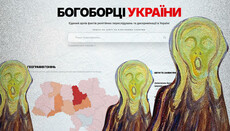
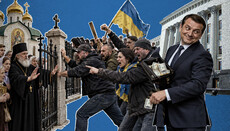
In May 2026, Ukraine’s “patriotic” social media sphere erupted in indignation over the launch of a new website called Godfighters of Ukraine, a project dedicated to defending the Ukrainian Orthodox Church. The site contains sections documenting church seizures, forced mobilization of clergy, violence against believers, and other incidents. It presents itself as “an online archive of facts concerning religious persecution in Ukraine.”
According to its creators, the project collects evidence of violations of believers’ rights, documents crimes, preserves the stories of victims of persecution, and compiles dossiers on those responsible for carrying out the campaign against the Church.
But the section that drew the greatest attention was titled “Persecutors,” where the names of individuals associated with incitement against the UOC or involvement in church seizures are publicly listed.
When persecutors begin speaking the language of victims
Liudmyla Fylypovych, an expert of the State Service for Ethnopolitics and Freedom of Conscience and one of the figures listed on Godfighters, erupted in an angry Facebook post, claiming that the creators of the project were calling for the murder of those featured on it. “The active persecutors have been named. Now – sic them! Is this not a call for their destruction??? It is time to open criminal cases, dear prosecutor’s office, because the lives and health of specific people are being threatened,” she wrote.
In the comments under the post, OCU “Bishop” Varsonofiy Rudnyk of Uzhhorod called the site “a list for the Muscovites, with a request for priority execution.” “And our special services, as always, close their eyes to such things. This is not a manifestation of democracy; it is a manifestation of open, undisguised collaboration and aggression against Ukrainians inside the country. And we still want a just peace…” the “hierarch” wrote.
MP Pavlenko, who helped organize the Tomos for the OCU, also saw in Godfighters not an archive of facts, but “hatred.” He wrote that “nothing testifies more strongly in favor of banning” UOC structures “as quickly as possible” than “the hatred they continue to sow.” According to him, from beneath the “sheep’s clothing” of those suffering for their faith, there peers out “the wolfish grin of hatred toward the Ukrainian Church, the state, and the people.”
OCU cleric Roman Hryshchuk and Greek Catholic hieromonk Yustyn Boyko went even further: they saw in Godfighters a parallel with the notorious Myrotvorets website, which for years published the personal data of thousands of Ukrainians who allegedly committed crimes against national security.
This reaction is telling.
People who for years broadcast hatred toward the UOC, called for seizures, searches, forceful actions, and the branding of millions of believers as “Moscow agents,” suddenly took offense when all these facts were collected on a single website and those involved were named.
The most astonishing statement came from Yustyn Boyko on the Lviv NTA television channel. According to him, Godfighters “brands people the way the communists once did, calling people enemies of the people.”
“This is an old practice dating back to Nero, who declared Christians undesirable to society, which became the cause of persecutions against them,” Boyko said, insisting that the site “brands everyone who dares say even one word of criticism against the Moscow Patriarchate.”
At the same time, Boyko himself called UOC parishioners in Lviv who secretly attend services in private apartments “Muscovites and traitors.” “These are people who have Patriarch Kirill, Putin, and the Russian world as their fixed idea,” Boyko said. According to him, “this disease is cured by time and death.”
A vivid example of double standards: a man openly lies and incites hatred against an entire group of people – UOC believers – but the moment someone says this out loud, he instantly repaints himself as an innocent victim whom “the communists are branding enemies of the people.” Yet is it not Boyko himself, through his rhetoric, who pushes the persecuted UOC parishioners of the Lviv region – those whose authorities have taken away or destroyed ALL their churches – into the position of real enemies of the people? And do not the absurd labels “Muscovites” and “Russian-worlders” turn them into outcasts?
Exactly the same logic can be seen in all the other figures listed on Godfighters. But why have they become so worried? After all, in essence, they are merely retransmitting the position of the authorities. Behind them stand the SBU, the media, any expert assessments they need, and the full power of the state.
Why is publicity so frightening?
On its “About the Project” page, Godfighters of Ukraine states its goal directly: to collect and systematize facts of religious offenses so that crimes are not forgotten and victims can defend their rights “both in Ukrainian and international institutions.” Is there anything reprehensible in this? For a democratic society – not in the slightest.
Here is another thesis from Godfighters: “The first stage of accountability for offenders is publicity. We make crimes visible and public.”
That, in essence, is what caused the panic. Publicity! By itself, it frightens the enemies of the UOC. But why? After all, most of the facts collected on Godfighters are already publicly available. Often the persecutors themselves publish the relevant photos and videos, themselves make angry statements on social media. They are not afraid to do all this and to speak of it aloud; they are not afraid to make it public either – so why panic when the same facts are simply assembled in one place?
The answer is simple.
The persecutors of the UOC wrap their misdeeds in bright ideological packaging. In that packaging, such a person appears before the public not as a persecutor of believers, but as a “patriot,” an “expert,” a “public figure,” a “defender of the state,” a “fighter against Moscow’s influence.” And everything he does is covered with fine-sounding slogans: “security,” “decolonization,” “spiritual independence,” “voluntary transfer of the community,” “the will of the people,” and so on.
Godfighters does something disarmingly simple. It strips away the ideological wrapping and presents the naked action itself.
Who struck whom.
Who cut church doors down with angle grinders.
Who stood nearby.
Who gave the blessing.
Who organized the operation.
Who carried it out.
And once detached from its “patriotic” narrative, what remains are plain facts – facts that may fall under criminal statutes and carry serious consequences.
That is when the real problem emerges:
Many people are willing to participate in the persecution of the Church.
Far fewer are willing to have their participation documented.
Take, for example, Liudmyla Fylypovych, whose angry post was quoted above. The site says of her that on the air of Channel 5, Fylypovych suggested dismantling UOC churches and moving them to the Russian Federation, while UOC believers should have their “brains cleansed.” Why was she not afraid to say all this on television, yet when that information appeared on Godfighters, she suddenly considered it a threat?
Because on Channel 5 all her words were wrapped in that same beautiful ideological packaging, while on Godfighters they are presented simply as a fact. A fact of incitement to hatred on religious grounds.
And Yustyn Boyko explains the cause of the concern. “Obviously, in some perspective, it will have a negative impact on people’s biographies, since it will be referred to. Sooner or later – if it has not surfaced already – it will surface at some international church meetings or even in international parliaments, where the Russian lobby will be working and will name the persecutors of the Moscow church,” the UGCC cleric said.
And while the passages about the “lobby” and the “Moscow church” are familiar false propaganda, the scenario in which the figures listed on Godfighters could face sanctions on international platforms is entirely realistic. Not to mention that practically all the individuals named fall under one or another article of Ukraine’s Criminal Code. And a time will come when those articles will begin to work.
Myrotvorets is okay, but Godfighters is not?
The comparison between Godfighters and Myrotvorets ("Peacemaker") looks especially caricatured. Because if that comparison works at all, it certainly does not work in favor of Godfighters’ critics.
The Myrotvorets website has long been known for publishing the personal data of people whom its authors considered a threat to Ukraine’s national security. Addresses, telephone numbers, places of work, and other personal information are published there.
Moreover, people sometimes end up on Myrotvorets not as individuals, but en masse – simply because they happened to be “in the wrong place at the wrong time.” For example, in 2016, Myrotvorets published the names and contact details of 4,508 journalists and media representatives who had worked in territories not controlled by Kyiv. Myrotvorets called all of them “accomplices of terrorists.”
This provoked a wave of protests from various human rights organizations. The ambassadors of the G7 countries in Ukraine stated that the mass disclosure of personal data on the Myrotvorets website put the personal safety of those people at risk.
In some cases, matters end in tragedy. For example, in 2015, Myrotvorets published the personal data of former MP Oleh Kalashnikov and journalist Oles Buzyna. Soon after the publication, both were murdered near their apartments.
Let us compare: Myrotvorets published the personal data of people, including journalists, with the ideological stigma of “terrorist accomplices” or “enemies.” Godfighters of Ukraine does not publish personal data and does not attach labels.
The difference is fundamental. While Myrotvorets directly indicated where and how an undesirable person could be found, Godfighters simply records violations of religious rights, naming public figures, their positions, and their actions.
Why, then, did people who calmly accepted Myrotvorets suddenly recoil in horror from a site that merely gathers facts and identifies the individuals involved?
They fear the light
The Gospel says: “For everyone who does evil hates the light and does not come to the light, lest his deeds should be exposed, because they are evil…” (John 3:20). This is not merely a moralizing phrase. It is a law of spiritual life. Goodness does not fear the light; it does not fear being seen. Evil, however, always needs fog, excuses, slogans, and the silence of its victims.
But when the victims stop being silent, when they begin to speak the truth, then we see the very reaction that followed the publications on the Godfighters of Ukraine website.