
Ukraine’s religious survey: measuring faith or measuring narratives?
On June 3, 2026, the Rating Group published the results of a nationwide survey titled “Assessment of the Religious Situation in Ukraine,” based on interviews with 2,000 respondents. The findings were later presented and discussed at a public event hosted by Ukrinform, attended by DESS head Viktor Yelensky, MP Mykyta Poturaev, political analyst Oleh Zakian, and others.
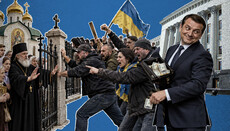
The survey results were presented by Rating Group co-founder Oleksii Antypovych. His conclusions outlined a religious landscape highly favorable to the current Ukrainian authorities: 60% of respondents reportedly view the creation of the OCU positively, 57% support banning the UOC, 67% approve of sanctions against Metropolitan Onuphry, and 79% believe the state should regulate religious organizations that are considered a threat to Ukraine.
On the surface, the picture appears straightforward. But a more careful examination of the data reveals a very different reality. Many of the conclusions being drawn from the survey are, at best, highly questionable.
Manipulation No. 1: Sociology during wartime
Many sociologists argue that opinion polls conducted during wartime – even when carried out professionally and in good faith – provide only a limited reflection of public sentiment. People are often reluctant to answer sensitive questions honestly.
In such circumstances, respondents naturally gravitate toward answers that align with the dominant public narrative. The use of telephone interviews, as in this survey, further increases the likelihood of socially desirable responses. Canadian political scientist Aaron Erlich, who has studied Ukrainian polling practices, has highlighted this very problem.
For this reason, the survey should perhaps be viewed less as a precise snapshot of public opinion and more as part of a broader information campaign supporting the policies of the current authorities.
Manipulation No. 2: “There is no conflict here – but there is one somewhere else”
Consider two figures from the survey.
Seventy-four percent of respondents describe relations between believers of different churches in their own communities as friendly or peaceful. Yet when asked about Ukraine as a whole, only 48% say there is no conflict, while 44% characterize interfaith relations nationwide as tense or conflict-ridden.
What does this mean?
It suggests that many respondents may personally know UOC parishes filled with ordinary Ukrainian citizens, served by normal clergy, where nothing remotely “anti-Ukrainian” takes place. Yet those same respondents have been persuaded by media narratives and social networks that somewhere else in Ukraine there exist dangerous “Moscow priests” who support Russia, promote the “Russian world,” and undermine the country.
A recent example illustrates this dynamic. OCU “Metropolitan” Serhii Horobtsov of Donetsk – who resides in Kyiv rather than in his own diocese – publicly described the UOC as an “enemy” and a “cancerous tumor.” He claimed that its clergy are “fighting for the souls of Ukrainians by depriving people of freedom, dignity, and the right to choose their future.”
Many people may believe such statements even while living next to a UOC parish where no one is deprived of anything.
Interestingly, Antypovych himself effectively acknowledged this mechanism during the presentation. If a respondent sees peace and harmony in his own locality but believes that religious conflict dominates the country as a whole, that perception is being shaped not by personal experience but by the broader information environment.
Manipulation No. 3: Treating “ties to the ROC” as an established fact
According to the survey, 57% support banning the UOC because of its alleged ties to the Russian Orthodox Church, while 67% support sanctions against Metropolitan Onuphry for the same reason.
For Viktor Yelensky and other critics of the UOC, these figures appear to validate their campaign against the country’s largest religious denomination.
Yet there is a significant problem.
The allegation that the UOC remains affiliated with the ROC was advanced by DESS itself – without a court ruling and without a genuinely independent religious examination. Government officials effectively attached a label to the Church, and respondents are reacting to that label rather than to a legally established fact.
In reality, on April 6, 2026, the Sixth Administrative Court of Appeal overturned the findings of the “expert examination” of the UOC Statute that had served as the basis for declaring the Church affiliated with the ROC.
The legal process concerning the possible prohibition of the Kyiv Metropolia of the UOC remains unresolved. Meanwhile, the UOC continues to categorically reject allegations of affiliation with the ROC, insisting on its complete independence and self-governance.
Nevertheless, the survey frames questions as though the alleged connection were already proven.
For example, among the possible answers to the question, “Why do you not identify with any denomination?” respondents were offered the option: “Because of the UOC’s ties to the ROC.”
Notably, UN experts raised concerns about this very issue in October 2025. They warned that labels such as “Russian world” and “pro-Russian church” are incompatible with the principle of legal certainty and risk criminalizing freedom of thought, conscience, and religion.
Manipulation No. 4: “We haven’t read it, but we condemn it”
The famous Soviet-era phrase describing people who condemned books they had never read may be the most fitting summary of this survey. People support sanctions while possessing very little knowledge about church life.
According to Antypovych, one-third of respondents do not know who Epifaniy is. Nearly 40% do not know Metropolitan Onuphry. 60% do not know the Ecumenical Patriarch. Yet 67% support sanctions against Metropolitan Onuphry.
How can someone consciously support sanctions against a person they do not even know?
The answer is simple. Respondents are reacting not to Metropolitan Onuphry himself but to the image that authorities, media outlets, and social networks have constructed around him.
The same lack of knowledge appears in responses concerning church identity. Twenty-four percent describe the UOC as an independent Ukrainian Church. Twenty-one percent view it as the Moscow Patriarchate. Forty-four percent cannot decide.
But if only 21% are convinced that the UOC is tied to Moscow, how can 57% support banning it precisely because of such ties?
Clearly, attitudes toward religious groups are shaped less by religious convictions than by media-generated perceptions.
Manipulation No. 5: Support for the OCU is more political than religious
The survey reports that 60% of Ukrainians view the creation of the OCU positively. Yet only 13% of respondents attend church services frequently or very frequently. Even among OCU and UOC adherents, regular attendance stands at only around 18%.
The largest “Orthodox denomination” in Ukraine is neither the OCU nor the UOC. It is the category of “simply Orthodox,” chosen by 26% of respondents. How many among them may actually belong to the UOC but prefer not to say so? That question remains unanswered.
Another 16% identify themselves as believers without belonging to any denomination at all.
These figures suggest that many Ukrainians view the OCU less as a church than as a symbol of Ukrainian statehood, independence, and national identity – a political phenomenon rather than a purely religious one.
Under such circumstances, detailed questions about ecclesiology, canonical legitimacy, or even regular participation in church life become secondary.
Manipulation No. 6: “There is no religious persecution”
According to the survey, 88% of respondents say neither they nor their relatives have experienced discrimination based on religion. Authorities cite this figure as proof that religious freedom in Ukraine is thriving.
Yet the same survey found that 5% reported experiencing discrimination personally, while another 7% said that family members or acquaintances had suffered religious discrimination.
In other words, approximately one in ten Ukrainians either experienced religious discrimination directly or knows someone who did.
And once again, one must ask how many people may have been unwilling to discuss such matters openly.
According to Social Policy Minister Denys Uliutin, between 22 and 25 million people currently live in government-controlled territory. If those percentages are extrapolated to the broader population, the numbers become enormous – potentially hundreds of thousands of people claiming some form of religious discrimination.
For a democratic state, that would hardly be a trivial issue.
Participants at the Ukrinform presentation inadvertently reinforced this point.
Viktor Yelensky acknowledged that DESS had received requests from UOC clergy seeking exemption from mobilization but had rejected them.
“We do not grant such exemptions,” he said.
What is that, if not discrimination based on religious affiliation?
Similarly, MP Mykyta Poturaev suggested that local authorities should determine “which denomination the territorial community belongs to.”
Yet Ukrainian law recognizes the right of religious self-identification only for religious communities themselves. What is this, if not a direct call to violate the rights of religious communities?
Manipulation No. 7: Are transfers to the OCU really a natural process?
According to the survey, 40% support communities transferring from the UOC to the OCU. Nine percent oppose such transfers, while 43% say they do not care.
The public is constantly told that Ukrainian society strongly favors the transfer of churches into the OCU. Yet even this survey suggests that support for such processes remains a minority position. More importantly, the wording itself is misleading.
Respondents were asked about “transfers” – implying voluntary changes of jurisdiction. They were not asked about forcible seizures, disputed votes, or contested re-registrations. In reality, many of the so-called transfers have been accompanied by precisely such controversies.
Most respondents likely understood the question as referring to voluntary decisions made freely by religious communities themselves. Yet the results are often interpreted as support for everything occurring on the ground, including confrontations and church seizures.
The contradiction becomes even more apparent in another finding. The survey claims that 49% of UOC believers themselves supposedly support transfers from the UOC to the OCU.
That stretches credibility.
It is difficult to imagine that half of UOC parishioners approve of losing their churches and property, seeing voting procedures manipulated, or watching communities re-registered against their will. And if half genuinely supported joining the OCU, why have relatively few such transfers occurred over the course of the war?
The answer may lie in how respondents interpreted the question. If they understood it to mean, “Should religious communities be free to decide for themselves which denomination they belong to?” then the result becomes far more understandable.
Comments from the commentators
Particular attention should also be paid to several remarks made by participants during the presentation of the survey.
Viktor Yelensky, for example, spoke of the “normality” of relations between believers of different denominations and claimed that the state had identified fewer than 20 localities where tensions existed over church transfers. Yet according to official statistics, Ukraine has approximately 30,000 populated localities.
Those fewer than 20 localities where Yelensky detected church-related conflicts amount to just 0.067% of the total. While a direct extrapolation would not be entirely accurate, the obvious question arises: where, then, did the 5% of respondents who said they had personally experienced religious discrimination come from? Or the additional 7% whose relatives or acquaintances reportedly faced such discrimination?
Another statement by Yelensky deserves attention. He argued that the state is demanding nothing from the UOC except that it leave the Russian Orthodox Church.
But the UOC maintains that it already has.
The decisions of the Council in Feofania on May 27, 2022, the official letter sent by Metropolitan Onuphry to DESS, and numerous other statements and documents all testify to this position. Yet none of this appears to carry any weight with the Church’s critics. Instead, they seek to dictate the exact form in which the Church must formalize its “departure.”
Is that not a direct intrusion into the internal affairs of a religious body?
Political analyst Oleh Zakian stated that “a cassock should not be grounds for indulgence.” In the context of the broader discussion, the remark was clearly directed at the UOC.
Yet two points should be made.
First, a cassock should not become a presumption of guilt either. UOC clergy increasingly find themselves treated as suspects simply because they serve in a Church viewed unfavorably by the authorities and segments of the media.
Second, the unlawful actions of individual clergy, where they occur, should not result in collective punishment for an entire religious organization.
The betrayal of Ukraine by certain Security Service officers during the first months of the war did not lead to the dissolution of the Security Service itself. Instances of collaboration by individual representatives of the police, National Guard, or prosecutor’s offices did not result in those institutions being banned.
Why, then, are different standards applied to the UOC?
Conclusions
The results of this survey reveal less about the religious state of Ukrainian society than about the effects of an aggressive and sustained media campaign against the UOC.
That campaign has produced several consequences.
First, it has entrenched in the public consciousness the image of the UOC as a body of dangerous “Moscow priests” working against Ukraine, while the alleged “ties to the ROC” are increasingly treated as an established and unquestionable fact.
Second, religious questions are no longer being perceived primarily as religious questions. They are being reframed as issues of patriotism, national security, and political loyalty.
Third, a significant portion of society lacks detailed knowledge of church affairs while simultaneously supporting harsh measures against the UOC.
Fourth, support for the OCU appears to be driven to a considerable extent not by religious commitment but by political and identity-based considerations. For many Ukrainians, the OCU functions less as a church and more as a symbol of Ukrainian statehood.
One day, the media campaign against the UOC will come to an end. One day, church matters may again be discussed in religious rather than political terms.
What will opinion polls show then?
And when that day comes, will anyone feel embarrassed by the numbers being cited today?