
When life is a battle: Priest-San: Confessions of a Samurai

“First, love those to whom you want to speak about Christ.
Then make them love you.
And only then speak to them about Christ.”
(St. Nicholas of Japan)
Yes, the price of saving a human soul is high. But if you are a warrior and God is with you, who can stand against you? The main thing is to let Him into your life and to know the path you must follow.
Young Russian director Yegor Baranov explores how to find – or avoid losing – that path, how to battle the “demons” within and without, and how to love one’s neighbor in his 2015 film Priest-San: Confessions of a Samurai. The film stands out not only for its original concept, but also for its cast, which includes the project’s screenwriter Ivan Okhlobystin and Mortal Kombat star Cary-Hiroyuki Tagawa. Its plot, too, proved far from straightforward.
Dressed in a priest’s cassock and Japanese sandals, an Orthodox priest from progressive Tokyo finds himself in a neglected corner of rural Russia. There is a certain irony here beyond the one that may occur to a Ukrainian viewer: his “predecessor,” St. Nicholas of Japan, brought Orthodoxy to Japan precisely from Russia.
The protagonist enters a world where “everything is falling apart” – spiritual values have been lost, morality is in decline, and people constantly lash out at one another. This is hardly surprising, since “where there is no church, there is no peace,” as Fr. Nicholas observes. He then sets about restoring both the church and the souls of the people in this story.
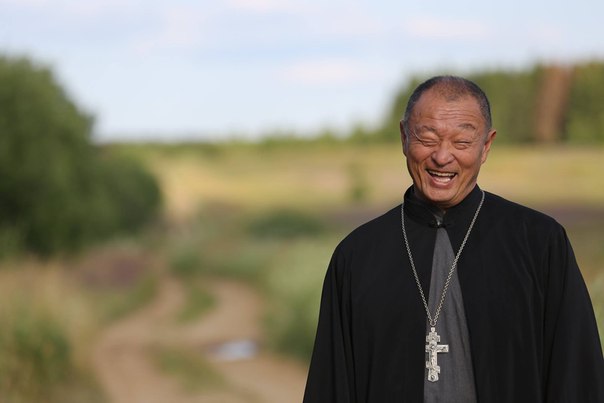
Through him, the lifeless sacred building at the center of all the film’s storylines gradually begins to come alive – as do those who take part in its restoration. Interestingly, the church in which the film was shot was genuinely being rebuilt at the time.
It is no coincidence that the climax unfolds in spring. Nor is it accidental that a child twice recites an excerpt from Sergei Yesenin’s poem Trinity in the Yard. Trinity is in the churchyard; Trinity is in the church; and Trinity has risen again in the souls of each of the characters.
Yet this is only the outcome. The road toward it passes through a series of difficult “operations” that each of the characters in Confessions of a Samurai must undergo.
Contrary to a widespread misconception, building a church is a process founded on faith, not on financial investment. Even when sponsors are available, nothing will come of it unless people put their hearts into the work. And there is only one obstacle preventing the human heart from opening – the person himself.
Each character must therefore battle an inner enemy – the passion that holds him captive: drunkenness, cruelty, envy, or selfishness. The film’s protagonist is no exception. By helping another person rise again, he finds healing himself. This, it seems, is precisely what happens to Fr. Nicholas.
“Find harmony amid discord, and opportunity amid hardship.” With these words, Tokyo’s ruling bishop blesses Takuro to leave Japan. This is precisely the outlook from which every one of us should live today.
Not everyone is given the chance to begin again from the very start, as Fr. Nicholas is. Yet anyone can make this very day a new beginning. Fr. Nicholas fails the test of faith in Japan, but he is given a “second chance” and makes worthy use of it.
And we come to understand that faith can be confessed anywhere. There are no “favorable” or “unfavorable” conditions for it. If you are with Christ, then you are always with Him – even in a place where “God has long been gone” and “the devils are everywhere.”
The Lord simply comes to each person differently, sending each one his own trial and his own decisive choice.
Former hockey player Pyotr faces such a choice. He once showed tremendous promise in sports, but a career-ending injury destroyed every hope of a successful future. He therefore drinks his life away, making not only himself miserable but also the woman who has not yet lost faith in him – his wife.
Through Fr. Nicholas, Pyotr realizes that it was not his life that ended, as he had believed, but his childhood. Now the time has come for him to fight for his life. Every character in the film ultimately faces the same necessity.
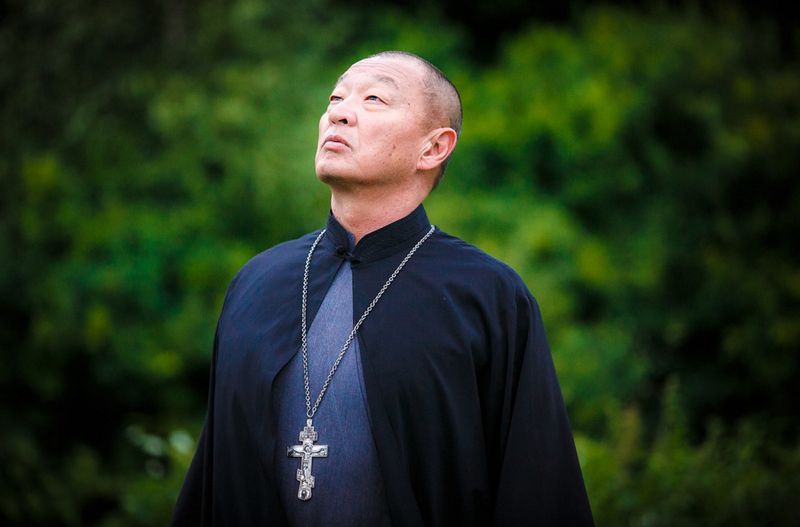
But can evil be resisted by using evil’s own methods? This question keeps viewers of Confessions of a Samurai in suspense from the very beginning.
A blow struck in defense of a woman, a blow struck in defense of the Cross – are these not worthy actions for a man, even if that man is wearing a priest’s cassock?
Yes – but only if aggression and hatred do not take possession of him. Otherwise, his actions will produce nothing but more evil, more division, and more death.
Righteous anger is possible, but only in the measure necessary to save another person, defend one’s homeland, or stand up for the faith. “Violence with noble intentions” always carries a danger: it is far too easy to cross the line.
It is therefore better to overcome evil by other means – through goodness, humility, and love. Fr. Nicholas ultimately learns to do precisely this, and he teaches the same lesson to his small but faithful flock.
(Note: As an Orthodox Christian with extensive experience in martial arts, Tagawa believes that a warrior’s battle is a special kind of struggle, because it rests on a clearly defined system of values, deep motivation, and proper spiritual guidance. For a priest, physical force can be permissible only as a last resort. First and foremost, he must allow God to act through him.)
It is no coincidence that the Life of St. Nicholas of Japan is mentioned at the end of the film. The saint displayed extraordinary courage, wisdom, and humility toward a man who could have become his murderer – and this made Nicholas the true victor.
At the beginning of his “confession,” Fr. Nicholas follows the samurai’s path of vengeance. In the end, however, he steps onto the Christian path – the path of forgiveness and love.
It is also significant that some of the first Japanese people to embrace Orthodoxy through St. Nicholas of Japan were themselves samurai.
The way of the samurai is the way of death: he lives as though his body were already dead. He understands that death may overtake him at any moment, and so he feels no fear and becomes stronger. This idea appears in Yamamoto Tsunetomo’s Hagakure: The Book of the Samurai.
The Christian path likewise means freedom from the fear of death, because “God is not afraid. Fear means an absence of humility, and that is a sign of an absence of faith,” as Metropolitan Athanasios of Limassol has said.
The samurai’s particular attitude toward death is also rooted in the conviction that the way a person dies reveals the way he lived. To a samurai, a life without honor is not worth living. A “worthy” death – even by harakiri – is therefore preferable to an “unworthy” life.
For a Christian, life has no meaning without God and repentance, whatever ending the Lord may prepare for him.
To be “dead” from birth, as the samurai’s path demands, may be a fitting prospect for a “fearless” warrior prepared to die for a code of honor, a lofty ideal, or “noble” revenge.
But this is not enough to make one a Christian. The Christian path is different from the way of the samurai. It demands no less courage and struggle, but it is impossible without self-sacrifice and love, because this is the faith revealed by our Lord Jesus Christ.
It does not depend on national borders, skin color, or the language any of us speaks. It lives “in the heart” and in the Church – though one must still make the journey to reach it.
Yegor Baranov’s film shows the road that leads there.
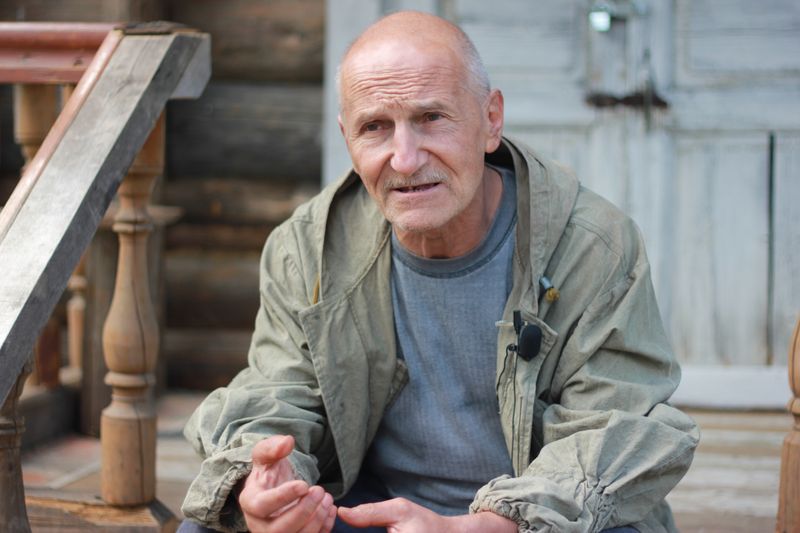
“Tell me, are you afraid of death?” Pyotr Mamonov’s character asks Fr. Nicholas.
“Were the wolves afraid?” the priest replies rhetorically, while the viewer’s attention shifts to the carcass of a wolf killed by a hunter.
Nothing can protect a person from the coming of death. Yet death itself is not what one should fear.
“I am not afraid of death. I am afraid of being unworthy to serve my Lord,” Fr. Nicholas concludes.
To be worthy of Him is the only principle that should guide a person in choosing which road to follow. It does not matter how much he may have to lose along the way. If that loss can save another person or help bring about the salvation of someone’s soul, there should be no hesitation – because that is how Christ Himself would act.
It is no coincidence that the bell acquires a special symbolism in the film. It rises toward the bell tower at the same time as each of the characters rises above his passions.
With every peal of that bell, the soul of the murdered Kolya will be present. His death becomes a “redemptive sacrifice” for the renewed lives of the others.
The bell falls at the very moment when the characters appear destined to face certain death inside the church itself. Yet when no hope of rescue remains but faith is still alive, the Lord Himself comes to their aid.
At moments like this, even the greatest cynic and miser cannot remain unmoved. In Confessions of a Samurai, Ivan Okhlobystin plays such a man.
The businessman Nelyubin lives by the principle that “whoever pays is God.” He possesses neither faith in the Lord nor even ordinary human decency. Yet he suddenly realizes that God alone stands above everything – and that He “is not mocked” (Galatians 6:7).

There is much that we, too, should reflect on after watching Confessions of a Samurai.
A parable, a sermon, and a missionary work in cinematic form, the film – as Ukraina.ru described it – teaches a faith in which there is no room for double standards.
“If it is Easter, we fast. But Christmas is an entirely different matter, because New Year’s Eve is just around the corner,” Nelyubin remarks ironically. And we understand that his words apply, to one degree or another, to every one of us.
The film shows that to be an Orthodox Christian is to be a “warrior” and a “fighter” who also possesses a loving heart – because only in this combination can faith be genuine.
It affirms that the life of a Christian is a battle, often a deadly one, but it is precisely through this battle that the soul is saved.
Instead of an afterword
There are undoubtedly things in Confessions of a Samurai that provoke resistance: elements drawn from the “finest traditions” of the 1990s – gangsters, corrupt police officers, and predatory businessmen; the clichéd portrayal of a hopeless rural backwater; and a somewhat superficial compilation of fragments from Eastern spiritual practices, pagan beliefs, and Orthodox tradition.
Yet Priest-San is far more than a depiction of the criminal underworld of a Japanese metropolis or the familiar lawlessness of a remote province.
It is a film about the spiritual causes of material consequences; about how the devil, moving among people, skillfully manipulates their passions; about a stained conscience and the Lord’s willingness, until the very end, to give a person the opportunity to cleanse it.
It is a film about the place of honor and family in human life, about a Christian’s inner principles, the power of prayer, and the importance of spiritual freedom.
It shows that every inward transformation begins when a person recognizes his own insignificance before the face of God and learns to forgive – especially when his neighbor is also his enemy.
It is a film about how every life becomes a “confession” once Love enters it.