
Everyday Life and Labors of the Lavra Brotherhood
Among the cardboard folders of the Central State Historical Archive of Ukraine lies fond number 128, preserving the memory of bygone centuries. Opening the yellowed sheets of paper and peering into the ink strokes of the scribes, one can attempt to discern living people behind the dry lines of reports.
Monastic life in the nineteenth century consisted not at all of uninterrupted contemplation and theological reflection. Within the lavra's buildings, complex and often arduous economic work was in full swing. The brotherhood labored, argued, fell ill, disputed with neighbors, and lit oil lamps before wonder-working icons. Archival documents reveal the life of the monastery without embellishment, in all its earthly fullness.
Thirty thousand folders of monastic history
The scale of the lavra's fond is striking. It contains more than 30,000 archival units. This body of documents exceeds the combined volume of all other monastic fonds in Ukraine. The documents span an enormous period from the fifteenth to the twentieth century.
The history of the archive itself proved dramatic. Some of the files were evacuated, and in the early nineteen-fifties, staff members sorted through one and a half tons of lavra documents discovered scattered loose within the fond of the ecclesiastical consistory. Every surviving folder preserves a fragment of a vanished era.
Let us look at the actual number of residents. In July 1838, the monastery counted one hundred and thirty-four monks, two hundred novices, and a hundred regular servants.
Decades later, the number of the brotherhood grew considerably. By the early twentieth century, more than five hundred monks and over six hundred novices were living at the Lavra and its outlying sketes.
Government decrees attempted to strictly limit the staffing of monasteries, prescribing that only a fixed number of residents be kept. But monastic life invariably broke any bureaucratic scheme. The streams of pilgrims, economic needs, and the internal influx of new people made such restrictions impossible to enforce.
Librarians, beekeepers, and the lavra choir
Behind every figure in the registers lies a specific human story. Here is the lavra's librarian — Hieromonk Nikolai (Rzhanitsin). In 1857, the church authorities entrusted him with compiling a detailed catalogue of the book collection. Father Nikolai diligently carried out this obedience for a full seven years.
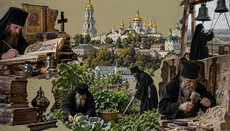
And here is a very simple laborer — Monk Timofei. By the early twentieth century, the monastery owned four apiaries with one and a half thousand hives, yielding hundreds of poods of honey annually. Monk Timofei successfully represented the lavra's beekeeping at an international exhibition in Kyiv, earning an honorary silver medal for improved husbandry.
The archive has preserved even the names of the choir singers of the nineteenth century. The list of choristers for 1848 includes Ianuary Solukha, Stefan Balandinsky, Theophylact Kalinovsky, Prokhor Stotsky, and Ivan Antonovsky. Alongside them, in the records of the icon-painting school, young novices Afanasy Petukhov, Isidor Chernyavsky, and Dmitry Lavrinenko are mentioned. They were learning to mix paints, apply gold leaf, and render the faces of saints on wooden panels.
The brick factory and the mills on the Lybid
Monastic labor was not confined to prayer in the church. The monastery conducted enormous economic activity. On the Lybid River, a brick factory operated, producing after technical reconstruction more than two million bricks annually. Dozens of hired workers were employed at the enterprise.
The monastery owned water mills in Holosiieve and on the same Lybid, grinding thousands of poods of grain. The monastery's guesthouses received up to two hundred thousand wanderers and pilgrims per year.
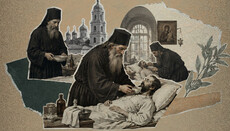
Particular attention was paid to medical care. The hospital department looked after the health of the brotherhood and ailing pilgrims. At that time, construction was completed on a new hospital with a house church, maintained at the expense of Metropolitan Flavian (Gorodetsky).
Such archival testimonies return us to a genuine understanding of the monastic feat. Behind the outward splendor of ancient churches there always stood the heavy daily labor of hundreds of people who had ordered their earthly lives in service to God and neighbor.