
Christmas without gloss: What the black cave on the icon keeps silent about
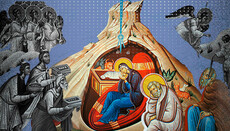
December smells of pine needles, mandarins, and anticipation. We are used to thinking of Christmas as the coziest holiday of the year. An imagination shaped by glossy cards draws an idyll: a warm wooden stable, golden straw, chubby rosy angels, and a happy Holy Family tenderly gazing at the Child. There is light, peace, and domestic warmth in this picture. We want to be there. We want to warm ourselves there.
But if we step into an Orthodox church and approach the analogion bearing the Nativity icon – whether painted by Andrei Rublev or by ancient Byzantine masters – we are in for a shock.
There is no coziness here. No gingerbread house. What happens here is something that takes your breath away.
Instead of soft straw – jagged rock ledges, sharp as knives. Instead of a homely hearth – a piercing, cosmic cold. This is not a family idyll; it is a tectonic shift of history. And if we look closely, we will see that the iconographer depicted not merely the birth of a child, but the beginning of a great battle.
The black hole of the Universe
Where does our gaze fall first? At the very center. But there is no radiance there. There is absolute, impenetrable darkness.
Against the ochre rocks yawns a black triangular cave. It is the darkest color on the painter’s palette. And it is not simply the entrance to a grotto where livestock hide from bad weather. In the theology of the icon, this blackness bears a terrifying name – “the jaws of hell.”
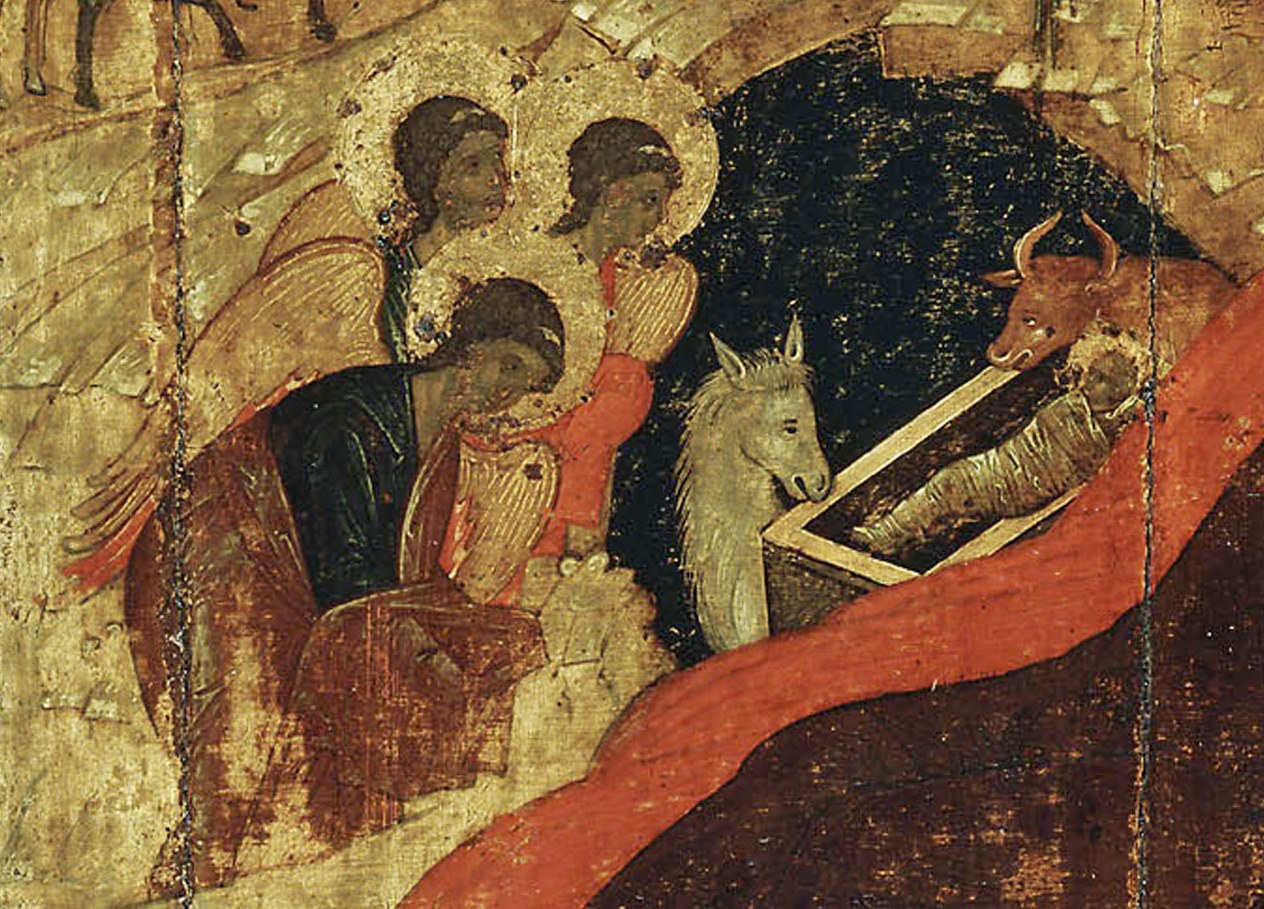
The icon speaks with brutal honesty: the world into which Christ comes did not welcome Him with open arms. This world lies in evil (1 John 5:19). It is a world struck by sin and death. The black cave is an image of all humanity deprived of God. It is the concentration of our pain, our despair, our wars and betrayals. It is the “outer darkness” (Matthew 8:12).
The greatest miracle happens precisely here. The light does not illuminate this cave from the outside like a spotlight. The light enters inside. Voluntarily. The Christ Child is placed directly into this blackness.
God does not recoil from our darkness. He does not demand that we first “clean up” our lives, turn on the light, and only then invite Him in. He is born at the very bottom of our fall. He lies at the epicenter in order to tear the darkness apart from within.
Born to die
Look at the Child. He does not resemble the cheerful toddler from Renaissance paintings. He is tightly swaddled in white bands.
Let us recall the iconography of another event – the Burial of Christ. These white swaddling cloths are identical to the burial shroud. And the stone manger in which He lies is disturbingly similar to a tomb, a sarcophagus.
At the most joyful moment of history, the Church does not allow us to forget the purpose of His coming.
He was not born for lullabies. He was born in order to die.
The white figure of the Child against the black background of the cave is a grain cast into the earth (John 12:24). Here, in Bethlehem, the shadow of the Cross of Golgotha is already visible. The icon does not hide it: the price of our salvation will be unimaginably high.
Turning away from the Son
There is another detail that often unsettles the modern viewer. Look at the Mother of God. She is the largest figure on the icon. She lies on a red couch, exhausted by childbirth. But where is Her gaze directed?
She is not looking at the Child. She is not pressing Him to Her breast. Often She is depicted turned away from Him.
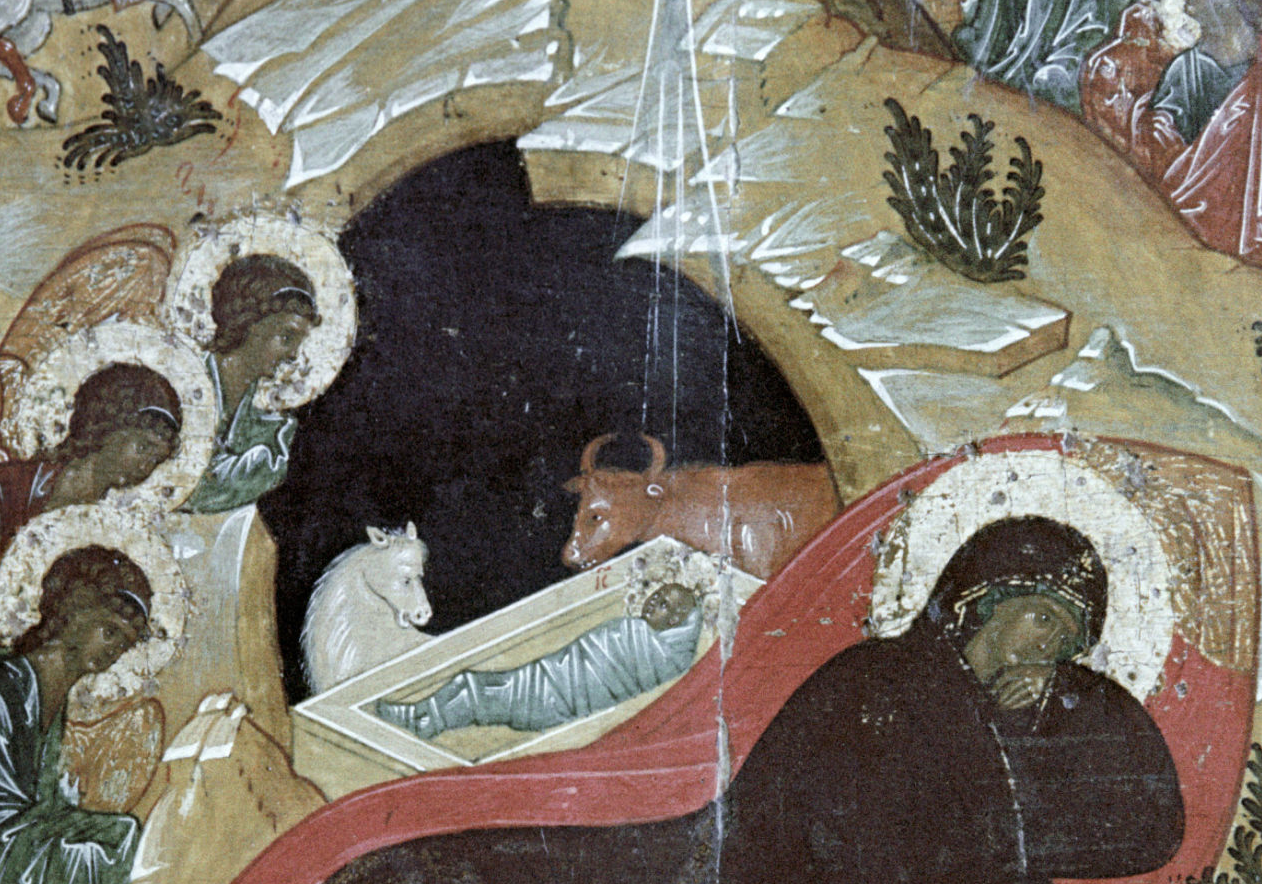
Why? Is there no maternal love here? There is. But it is a love higher than attachment.
The iconographer shows us Mary who has already made Her sacrifice. She understands that this Child does not belong to Her. He belongs to the world.
She turns away not out of indifference, but out of humility before the mystery. There is deep contemplation in Her posture – that very “pondering of words in Her heart” (Luke 2:19). She looks at the world – often at us – with boundless sorrow and hope. She knows that a sword will pierce Her soul (Luke 2:35). And She silently accepts this.
The corner of doubt
Now let us shift our gaze to the lower corner of the icon. There sits an old man. This is Joseph the Betrothed. He sits with his head resting on his hand, in a pose of deep sorrow and reflection. He does not partake in the angels’ celebration. He is alone. Beside him there is often a strange figure – a hunched old man in goatskins, leaning on a crooked staff. Who is this? A shepherd?
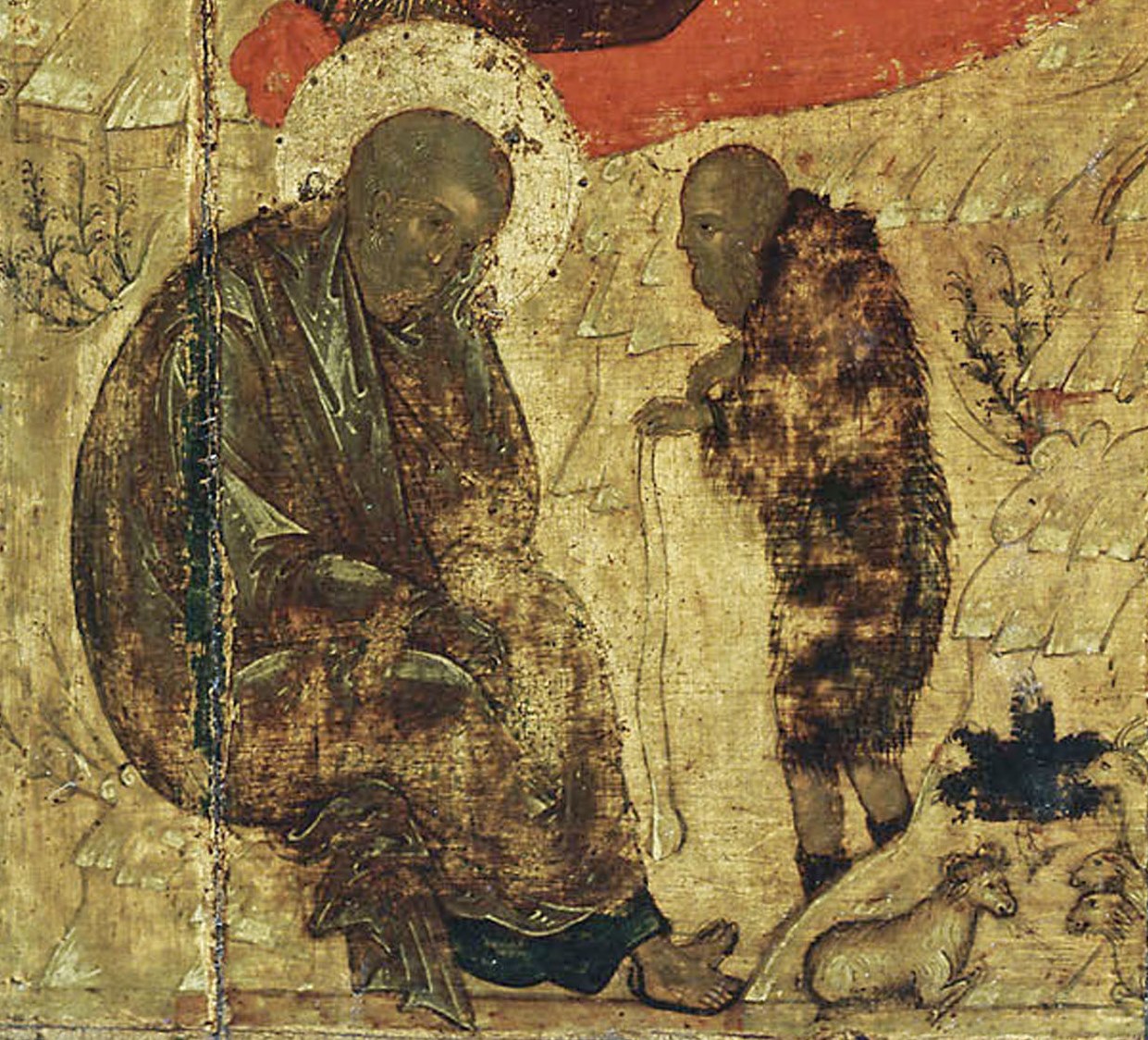
Ancient interpretations say: this is the “spirit of doubt,” a demon tempting Joseph. He whispers the thoughts so familiar to every one of us: “How can a virgin give birth? This contradicts the laws of nature. It is impossible. You have been deceived. There are no miracles, Joseph. There is only the dry staff in my hand and stones beneath your feet.”
This is the most piercing psychological moment of the icon. A thriller inside the feast.
While Heaven rejoices, while the Magi hasten with gifts and the shepherds listen to angels, one man sits in a corner, painfully trying to believe.
We recognize ourselves in Joseph. Do we not often sit in this “corner of doubt,” living in a world full of pain and injustice? We too are whispered to: “There is no God. Evil has won. Look at the news – where is your Christmas? These are just fairy tales.”
The icon does not condemn Joseph. It gives him a place in the composition. The Church understands: faith is not always an ecstatic flight. Sometimes faith is simply the courage not to leave, to remain sitting by the cave, even when reason screams, “I don’t believe.”
Comfort through truth
Why, then, does this severe icon comfort us today more than a glossy Christmas card?
Because gloss lies. If Christmas were merely a sweet family story, it would crumble at the first collision with reality. The cozy stable from the picture would not survive shelling. Rosy-cheeked angels would not save us from the fear of death.
But the icon tells the truth.
God came not into a gingerbread world. He came into a world with cold rocks, black caves, betrayal, and death.
He came into a reality that smells of dampness and blood, not cinnamon. And precisely because of this, we have hope.
Christ lies in the black cave of our pain. He is here. At the darkest point of life, in the deepest pit where there seems to be no place for light – He is already there. Quietly… Do you hear it? In this blackness a living heart is beating.
God is born. And the darkness did not overcome Him (John 1:5).