
Spiritual engineering in besieged Constantinople
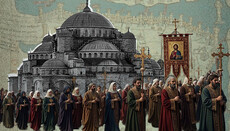
The liturgical Typikon of the Cathedral of Constantinople, known as the Typikon of the Great Church and compiled in the 9th–10th centuries, has survived to the present day. It contains concise lists of dates, churches, and procession routes. Altogether, the Typikon records up to thirty-five mandatory citywide processions each year, with precisely designated stops along the Mese, the city's main thoroughfare: from Hagia Sophia through the Augusteon and the Forum of Constantine, past the Forum of Theodosius, to the Church of the Holy Apostles or the Church of St. Mary of Blachernae on the city's outskirts. For several hours, the entire city became a church without walls, where a mass communal liturgy was celebrated.
We tend to picture a medieval religious procession as a crowd of worshippers carrying smoking torches, wandering almost at random while chanting church hymns. But the instructions in the Typikon read more like military orders: who sets out from which point, where the procession halts, and which antiphon is sung at each intersection. Such order was maintained not only in times of peace. Let us now turn to what happened when peacetime came to an end.
Siege and the procession with the icon
In the summer of 626, Emperor Heraclius led the Byzantine army to the Persian front. In his absence, Constantinople came under simultaneous attack by the Avars and their Slavic allies from the west and the Persians from the Asiatic shore. The city was actually left in the care of Patriarch Sergius and the patrician Bonus. Catapults pound the city walls, and by all the conventions of the genre, what follows should be a chronicle of desperate defense: breached walls hastily repaired, nighttime sorties, and an ever-growing shortage of water.
The chronicles do indeed record all of this. But alongside the descriptions of the fighting, the sources report something else. Patriarch Sergius organized a procession along the fortress walls with an icon of the Savior in full view of the besieging forces – directly during the bombardment.
Contemporaries describe this event as part of the military defense.
The city held out – the walls withstood the enemy's assault, the fleet burned the Persian rafts on the Bosphorus – but the panic within the city never escalated into revolt or surrender, although all the conditions for this were in place.
Two earthquakes, two different responses
It is worth comparing two interesting cases separated by one hundred and ten years.
In 447, a series of tremors brought down a section of the newly completed Theodosian Walls of Constantinople. Fifty-seven towers collapsed simultaneously. The city found itself on the brink of famine and invasion (Attila was already nearby).
Emperor Theodosius II's response to this challenge appears almost reckless: together with Patriarch Proclus, he removes his crown, takes off his shoes, and leads a procession of clergy and citizens beyond the city walls, into the open field.
Church tradition associates this procession with the birth of the prayer "Holy God." The account of a boy lifted into the air before the crowd and hearing angelic singing should be understood as a pious legend, but the historical fact of a mass penitential procession beyond the walls of Constantinople is well attested.
The earthquake of 557 was far more devastating. Agathias of Myrina, an eyewitness, writes of a city “almost wiped off the face of the earth.” The dome of Hagia Sophia collapsed, sections of the walls gave way, and many inhabitants perished. But Justinian I responded to it differently than his predecessor. Instead of walking barefoot into the open field, there were forty days of mourning, entry into the church at Christmas and Theophany without a crown and bareheaded – and, more importantly, the establishment of an annual penitential service in memory of that day.
The Forum where the Emperor became a common man
Routing the prayer procession specifically through the Forum of Constantine was a carefully considered decision. There stood a porphyry column, a monument to the city’s founder, and here the worshippers crossed the political center of the capital.
Walking in the general procession, among the crowd rather than in enclosed litters, the emperor ceased, for a few minutes, to be an inaccessible ruler, becoming an ordinary layman.
Historians have not reached a consensus on what these processions actually meant. Since the time of Gibbon, liturgical processions have been interpreted as a form of state theatre. The glitter of gold and censers was thought to hypnotize the impoverished crowd and uphold the imperial throne. There is also another reading of the symbolism of the processions: rather than serving the interests of the palace, the liturgy instead took urban space out of the control of power, compelling the secular polis to submit, for a few hours, to a different rhythm. The sources do not provide a definitive answer as to which interpretation is correct. Most likely, both are true at once, in varying proportions at different times.
Order within the crowd was maintained not by soldiers. By this time, the urban demes, once organizers of chariot races in the Hippodrome, had long since evolved into semi-military corporations with fixed ceremonial duties.The treatise On Ceremonies by Constantine VII Porphyrogennetos records their presence at certain points along the procession, where they proclaimed the prescribed acclamations. The crowd did not murmur chaotically – it was divided by specially trained people into manageable sectors.
The dome where anxiety drowned
The final destination of the most solemn processions was almost always Hagia Sophia. Here Byzantine engineering revealed itself in its full splendor.
The architects Anthemius of Tralles and Isidore of Miletus built the church not for beauty alone. Modern acoustic measurements have calculated the reverberation time beneath the dome at approximately ten to twelve seconds. By comparison, in an ordinary concert hall today this figure barely reaches two seconds.
No voice fades here instantly, as it would in any residential or civic space of that era. It lingers in the space and multiplies, enveloping the crowd from all sides.
The city outside might be cracking under the strain of panic, earthquakes, or siege engines. But a person who had walked in prayer with the common procession to the city's principal shrine found himself inside a space that held him in place through sound, instilling calm and strengthening faith.