



Zelensky's greetings: when Christmas is without Christ
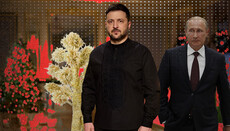
The analysis of Zelensky's Christmas message allows for a clear conclusion: it has nothing to do with the Christian worldview.
The Christmas message from the head of state is an important event that informs the people not only of the political position of the authorities but also speaks of the spiritual state of society itself. When the leader of the country that calls itself Christian addresses the people on the eve of the great feast of the Nativity of Christ, it is expected that his words will be imbued with the spirit of the Gospel, pointing to the central event of this day – the appearance of the Savior in the world. However, the text delivered by Volodymyr Zelensky on the eve of the new-style Christmas 2025 raises serious questions both from the perspective of Christian theology and in terms of what worldview actually prevails among the top leadership of the Ukrainian state.
Magic instead of grace
The address begins with the words: "It is a unique time, filled with a special spirit, with its own special magic for all of us." Already in the first phrases, we encounter a non-Christian understanding of what is happening. Zelensky speaks of the "special magic" of Christmas. But for a Christian, the word "magic" has a clear semantics: it is an attempt by a person to manipulate spiritual forces, to subordinate the supernatural to oneself, and moreover, to enter into contact with the otherworldly through certain rituals and spells.
Magic is paganism, not Christianity.
The use of the word "magic" in the context of a Christian feast reveals a purely occult, pagan perception of the one who uses it. Yes, for a pagan, a holiday is indeed a "special time" when the boundary between worlds becomes so thin that one can appeal to the forces of nature or the spirits of ancestors. But a Christian knows that the boundary between God and man was overcome not on some special night that has ritual or magical significance, but at a specific historical moment when the Son of God took on human nature and was born in Bethlehem of the Virgin Mary.
Family dinner instead of meeting with God
Further, the president develops his thought: "This evening is truly about all of us. About everything that makes Ukrainians who we are. It is love for our home, our roots, and our traditions. It is the happiness of the whole family gathering around one table – finally meeting, embracing one another, and asking each other, “How are you?” All of this has always been an inseparable part of our Christmas."
Here we see a classic substitution of concepts. Christmas is declared a "Ukrainian" holiday, where the main value is claimed to be the opportunity to meet and communicate with relatives at the family table. In essence, for Zelensky, Christmas turns into a celebration of Ukrainian identity, culture, and traditions.
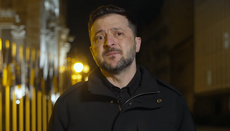
We will disappoint Zelensky and those who believed him: Christmas is a universal holiday for all humanity. Christ was born neither for Ukrainians, nor for Russians, nor for Americans – He was born for all people. "For God so loved the world that He gave His only begotten Son, that whoever believes in Him should not perish but have everlasting life." (John 3:16). And when we start saying that Christmas is about "us, Ukrainians," we turn the Good News of salvation into a purely national element.
Then the President lists what, in his opinion, is "an inseparable part of our Christmas": love for one's home, roots, and traditions, happiness of family-gathering, meetings, hugs, the question "How are you?". All these are undoubtedly beautiful manifestations of human communication. But are they "integral attributes of Christmas"? From a Christian point of view – categorically no.
An integral attribute of Christmas is the meeting with the Christ Child. It is the worship of the Magi, who brought their gifts. It is the shepherds who left their flocks and came to Bethlehem to worship Christ. It is the angelic hymn "Glory to God in the highest, and on earth peace, goodwill toward men." (Luke 2:14). It is the joy that "there is born to you this day in the city of David a Savior, who is Christ the Lord." (Luke 2:11).
Family dinner, meetings of relatives, feasting – all this can accompany the holiday, but this is not the essence of the holiday. For a non-nbeliever who does not believe in Christ, Christmas indeed remains only an occasion to gather at the table. But for a Christian, the center of the holiday is the One who was born that night, not the feast.
And if in the Christmas address of the head of the Christian country this is not mentioned, if Christ is replaced by "family values" and "Ukrainian traditions" and the idea that everything should be "delicious" for us, then this testifies to a complete misunderstanding of the essence of Christianity.
Gastronomic materialism: "when we have a delicious meal"
Particular attention should be paid to the President’s repeated references to food. "And this is exactly what we are defending today: our land, our families, that longed-for feeling of peace and calm in our own home. When we are warm. When we have a delicious meal." Then this topic arises again: "it does not matter whether we are apart or face to face – Ukrainians." And in the end: "I wish a happy Christmas, delicious kutia."
Why does the President return to the gastronomic theme so many times? Why is the word "delicious" used twice, why is there talk about dishes on the table, about kutia? From a rhetorical point of view, such repetition is not accidental – it indicates the importance of this aspect for the speaker.
What does this say? That Zelensky focuses on the material, the carnal, the earthly. Christianity does not deny the legitimate bodily needs of a person, but it never makes them central. The Apostle Paul says: "Food is for the stomach and the stomach for food, but God will destroy both it and them." (1 Corinthians 6:13). Jesus Christ teaches: "Do not worry about your life, what you will eat or what you will drink." (Matthew 6:25).
It should be noted that before Christmas, Orthodox Christians observe a fast. This fast was established precisely to prepare the soul for an encounter with Christ, so that by restraining the flesh one might assist one’s prayer. It is obvious that after such preparation, the first thing that should come to a Christian’s mind is not “how delicious,” but rather “how great is our God, who has come into the world.”
In Zelensky’s words, one hears a purely consumerist attitude toward the holiday. Christmas is turned, for him, into a feast of the belly, a celebration of gastronomic pleasure. Once again, all of this is closer to the pagan Saturnalia of Ancient Rome than to the Christian celebration of the Incarnation.
Division instead of unity
It is striking how many times the thought of the unity of Ukrainians is repeated in the message. "When we are together. And despite everything, we are together today"; "it does not matter whether we are apart or face to face – Ukrainians… Ukrainians are together"; "Ukrainians are together tonight – marking Christmas on the same date, as one big family"; "we are side by side today", etc. Zelensky constantly returns to unity, repeating this thesis over and over again.
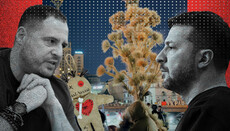
But why is it necessary to talk about unity so insistently? Usually, what is obvious and natural does not require constant reminders. But when a person repeatedly assures that "we are together," one simply needs to ask: is this really the case?
Answering this question, it is impossible not to say that the reality in which Ukrainian society lives today is a deep division. Moreover, this division is largely artificially created by the very policy of the authorities. Ukrainian society is divided by language (one can recall thousands of cases of language discrimination in Ukraine), by religion (a real war is being waged against the UOC), by economy (some think about how to live on a pension of 3000 hryvnias, others steal billions), divided into "draft evaders" and drafters.
Moreover,
the very change of the date of Christmas celebration at the state level is a tool of division.
Until recently, all Orthodox in Ukraine – both the UOC, the UOC-KP, the OCU, and Greek Catholics, and Catholics – celebrated Christmas as they saw fit. Now the state has decided to force people to abandon their traditions.
When the President says that "Ukrainians today are marking Christmas on one date as one big family," – this is not just a lie. These words sound like mockery toward the millions of Ukrainians who will celebrate Christmas in two weeks, on January 7 under the new calendar.
Another phrase deserves attention: “And it hardly matters what dishes are on the table – what matters is who is at the table.” Here there is a clear hint that some people are not welcome at that table. But if the discussion is about “unity” and a “big family,” if it is claimed that “all Ukrainians are together,” then why does the question of who is at the table even arise? Does a family divide its members into “worthy” and “unworthy” of sitting at a shared festive meal?
Zelensky’s phrase says more than many words about the fact that, in reality, unity is conceived only among the “right” Ukrainians –those who have passed a test of loyalty. Only “one’s own” should sit at the table, not just anyone. And the criteria for belonging to this chosen group, judging by the context of the entire address, have nothing to do with Christian virtues; rather, they concern political and ideological loyalty.
“The Ukrainian heart” as a new Idol
It is precisely for this reason that Zelensky asserts: “And despite all the suffering that Russia has brought, it is not capable of occupying or bombing what matters most. That is our Ukrainian heart, our faith in one another, and our unity.”
Here we see yet another form of pagan thinking – the deification of the nation. “The Ukrainian heart”, “faith in one another,” and “our unity” are declared the most important, something that cannot be destroyed or occupied.
But may I ask: for a Christian, should the most important thing be a national heart? Is it not said: “You shall love the Lord your God with all your heart, and with all your soul, and with all your mind: this is the first and greatest commandment” (Matthew 22:37–38)? Neither Judea, nor the Roman Empire, nor modern Ukraine, nor any other nation.
For a Christian, the most important thing is God, the eternal salvation of the soul, and the Kingdom of Heaven. Everything else, including national identity, is secondary. The Church Fathers taught that a Christian is a citizen of the heavenly Fatherland, while the earthly fatherland is only a temporary dwelling on the way to eternity.
Moreover, it often happens that a person changes several states during their lifetime, even while living in the same place. Should they then change their heart along with their passport and citizenship?
"But seek first the kingdom of God and his righteousness" (Matthew 6:33), says Christ. And when the national replaces the Divine, when the “Ukrainian heart” is declared the most important, we are dealing with typical idolatry, where the nation is turned into a deity and given absolute value.
But when we try to build our identity, our unity, our values without Christ, we are building on sand. Sooner or later, this structure will collapse, because it lacks a firm foundation.
Denial of Christian ethics
Zelensky calls Russians “godless,” people who have “nothing in common with Christianity or anything human”. But let me ask: are the actions of the Ukrainian authorities toward the UOC faithful not godless? Is the seizure of churches, the beating of worshippers, the arrest of priests, the banning of the canonical Church Christian behavior? Is changing the dates of church feasts by government decree, interfering in the Church's life, or imposing a schism not godless?
This creates a strange situation: the enemy is accused of godlessness for military actions, yet one’s own godlessness toward the Church goes unnoticed.
The true climax of anti-Christian sentiment in Zelensky’s address comes in the following passage: "Since ancient times, Ukrainians have believed that, on Christmas night, the heavens open. And if you tell them your dream, it will surely come true. Today, we all share one dream. And we make one wish – for all of us. 'May he perish' (‘щоб він сконав’ – Ed.), each of us may think to ourselves. But when we turn to God, of course, we ask for something greater."
Here we encounter several problems at once.
First, the President refers to the popular belief that on Christmas night “the heavens open” and one can make a wish that will inevitably come true. This is pure occultism and magical thinking. The heavens do not open to fulfill our desires – they opened at the moment of the Incarnation, when the Son of God came down to earth. Christmas is not a time for magic or making wishes; it is a time to encounter God.
Second, the President speaks of addressing the “heavens” rather than God. Let us recall that Christians do not turn to the elements, nor to some abstract cosmic force but to a personal God. Addressing the “heavens” is once again paganism, pantheism, and a belief in an impersonal force of nature.
Third, and most horrifying, is
the public wish for someone’s death: “May he perish.” It must be emphasized that the very idea of wishing death upon someone is completely incompatible with Christianity. And these words sound particularly shocking on Christmas Eve.
Wishing death upon another person is a grave sin. It is a violation of the commandment “You shall not murder,” because anger, hatred, and the desire for death are already murder in the heart, as Christ teaches in the Sermon on the Mount (Matthew 5:21–22).
The President of the Christian country, in his Christmas message, essentially “blesses” this wish for death. He speaks as if “each of us may think to ourselves” these terrible words. He legitimizes hatred, making it part of the national consciousness. And this happens on the Christmas Eve, when the One was born who came to give life, not death!
There is another oddity in this phrase that deserves attention. Zelensky says: “‘May he perish,’ each of us may think to ourselves.” The wording is extremely unfortunate, because it gives the impression that a person is somehow wishing death upon themselves. Of course, something else was meant. But the very sound of this phrase shows how careless and ill-considered the text is. Or perhaps, on the contrary, the text was composed this way deliberately, and this phrase is simply a “Freudian slip”, indicating the self-destructive nature of the hatred cultivated by the Ukrainian authorities in the person of Zelensky?
Comparison with American greetings
For a complete picture, it is important to compare the address of the Ukrainian President with the Christmas greetings of American politicians. U.S. Secretary of Defense Pete Hegseth said: “Merry Christmas to all. Today we celebrate the birth of our Lord and Savior, Jesus Christ. May His light bring peace, hope, and joy to you and your families.”
Secretary of State Marco Rubio: “The joyful message of Christmas is hope for eternal life through Christ. I wish everyone a blessed holiday season filled with hope and peace.”
Notice that both American politicians, in their brief greetings, clearly and directly name the essence of the holiday – the birth of the Lord and Savior, Jesus Christ. They speak about Christ, His light, and hope for eternal life through Him. They use Christian terminology: “Lord,” “Savior,” “blessed season,” “eternal life”, etc.
The USA, like Ukraine, is a Christian country. In Ukraine, in addition to the OCU, Christmas on the new calendar, December 25, is traditionally celebrated by Catholics and Greek Catholics. The Ukrainian President has a Christian tradition he could have drawn on in his address. But instead, we received a text in which Christ is mentioned only once – at the very end, and even then in the context of caroling.
Even this single mention of the Birth of the Son of God is not placed at the center of the message, not as the main idea, but as an element of folk tradition. In other words, Christ appears in Zelensky’s text not as the living God who came to save the world, but as an element of ethnography.
At the very end, the words do appear: “…the day when everyone gathers at home in the first peaceful year, at a peaceful Christmas, and says to one another: 'Christ Is Born! Glorify Him!'” But these words are merely a quotation of the traditional Christmas greeting, spoken as a formula, as an obligatory element devoid of any inner substance.
Conclusions
The analysis of Zelensky’s Christmas message allows for a clear conclusion: it has nothing in common with a Christian worldview. In this text, we see a pagan and magical perception of the holiday, a substitution of Christ with national identity, where, instead of encountering the Infant God, one is offered a meeting with the “Ukrainian heart”.
The Christmas message is not just a ceremonial speech. It is a mirror reflecting the spiritual state of our people and their leaders. What we saw in this mirror on Christmas Eve is alarming.
What is happening to our faith, our Church, and our people? Have we really stopped distinguishing good from evil, Christ from Belial? Are we truly unable to understand that the path we are following leads to an abyss?
We want to believe that this is not so. We sincerely hope that next Christmas we will hear not wishes of death but words of joy about the newborn Savior. Words filled with peace, love, and the Good News: “Christ is born; glorify Him! Christ comes from heaven; come to welcome Him! Christ is on earth; lift up your hearts!”