
Shelter beneath the vaults: how church twilight heals us
We cross squares flooded with neon and try to dodge endless streams of traffic. The modern city leaves almost no room for a person to hide, to be alone with their thoughts. We have been taught that every public space should be illuminated like an operating room. Glass-and-concrete offices, supermarkets drowned in white brightness, flat LED panels overhead – this sterilized glare is presented to us as the very definition of comfort.
But that is an illusion.
In reality, this relentless, eye-straining brightness has long become a form of subtle violence against the human psyche. Like a theatrical spotlight, it demands that we constantly remain on display, conform to social expectations, and project endless positivity. We are expected to look flawless, smile at colleagues, and convince everyone that life is going perfectly.
Meanwhile, exhaustion quietly accumulates within us.
Ancient church architecture offers a complete rejection of this culture of perpetual display. The moment we open the heavy doors of a church and step across the threshold, we are enveloped by gentle darkness. We pause near the entrance, allowing our eyes to adjust, and as our pupils widen, we can almost feel our habitual anxiety begin to loosen its grip.
The half-light of the church is not accidental.
It is an architecture of salvation built through shadow.
The architecture of Byzantine refuge
Standing beneath the massive arches of a cathedral, our gaze instinctively rises upward. The traditional cross-in-square design of Byzantine church architecture created a carefully structured hierarchy of light.
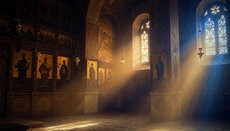
Windows were placed almost exclusively in the upper sections of the building – in the narrow drum beneath the dome. From that heavenly height, sunlight descends in sharp rays, cutting through air thick with incense.
Yet the lower levels of the church, where people stand and pray, were intentionally left in subdued shadow.
The architects of the past were not limited by technology. They knew perfectly well how to create vast openings and flood interiors with light, as the monumental architecture of Constantinople abundantly demonstrates. Yet in ordinary churches they deliberately fashioned spaces of visual silence.
In that shadow, we can conceal our fatigue, our imperfections, our unseen ruins.
The Church grants us permission to be weak. It gives us the right to withdraw, if only briefly, from the harsh and judging gaze of the crowd.
Here, no spotlight exposes our wrinkles, the traces of chronic sleeplessness, or our worn-out clothes. Darkness transforms the church from a public hall into a sanctuary of intimacy – like the hands of a mother shielding the face of a frightened child.
The living breath of gold leaf
When our eyes turn toward the iconostasis, the half-light reveals another of its mysteries.
Direct a modern LED spotlight onto an ancient icon, and a small disaster occurs. The image instantly becomes flat and lifeless. The gold leaf of the halos resembles cheap metallic foil, while the earthy pigments lose their depth and warmth.
Even this description may be too gentle.
Electric light kills the artwork, reducing sacred space to a museum exhibit.
Inside a church, however, everything is different.
The priest and theologian Father Pavel Florensky wrote extensively about the aesthetics of sacred art. In his view, icons were never intended to be viewed under electric lighting. They were created specifically for illumination by the living flame of a beeswax candle or an oil lamp.
Before a lampada, the icon comes alive. The golden background recedes. The saint’s face seems to move, breathe, and enter into conversation with the person standing in prayer.
Candlelight never assaults the eyes. It gently guides the gaze away from the chaos of the external world and toward the contemplation of deeper realities.
Warm light against the blue spectrum
Modern science largely confirms the intuition of the ancient Church.
LED screens and fluorescent office lighting emit large amounts of blue-spectrum light. Our nervous system interprets this spectrum as a signal that it is perpetual midday. The brain suppresses the production of melatonin and releases cortisol – the hormone associated with stress and vigilance.
The body enters a state of permanent alertness.
Its resources gradually become depleted, leading to exhaustion and burnout.
Natural beeswax burns very differently.
Its flame produces a warm glow of approximately 1800–1900 Kelvin – soft red and yellow wavelengths remarkably similar to the light of a setting sun.
The body immediately recognizes this ancient signal as a sign of safety.
The parasympathetic nervous system activates. The heartbeat slows. Muscular tension eases.
A beeswax candle functions as the perfect anti-screen. Its warm flame flickers like a living heart, restoring our connection to the deeper rhythms of the soul.
The saving darkness
Ancient Christian writers often described the highest stages of knowing God not as blinding brilliance but as mystery concealed within darkness.
In his treatise Mystical Theology, St. Dionysius the Areopagite introduces the profound concept of the “Divine Darkness” – the gnophos.
Addressing his disciples, the saint explains that God dwells where the abundance of light appears to us as darkness because of the limitations of human perception.
The light of God surpasses our spiritual vision so completely that we experience it as unfathomable darkness. This Divine Darkness protects us from the overwhelming majesty of the Creator.
We cannot fully comprehend God through our limited intellect, but we can entrust ourselves to His providence.
God shelters us within this shadow.
The golden halos of distant icons shimmer softly, offering a quiet promise of the eternal joy to come.
Standing at an evening service, we watch a final stripe of sunlight slowly climb the church wall before disappearing into the vaults above. Clouds of incense gradually dissolve, carrying away the remnants of the day's worries. Below, drops of melted wax slide down the candle stand and harden into strange and beautiful forms.
The face of a saint on an old icon becomes almost invisible as twilight deepens.
Only the tiny flame of a lampada continues to tremble gently in the darkness, maintaining a fragile connection between earth and Heaven.
And suddenly we understand how desperately we need sacred places where we can step away, if only for a moment, from the exhausting marathon of modern life.