



An Easter homily about a showdown in the vineyard
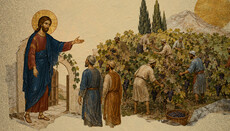
The vineyard owner pays the latecomer exactly as much as the man who worked from dawn. That was the Savior’s great challenge to our sense of fairness.
Imagine a marketplace in Jerusalem at daybreak. Standing there are men whom no one has hired. In ancient Palestine, a day laborer was someone with no food reserves to fall back on. If no one hired you today, your children would go hungry.
The owner of a vineyard comes to the marketplace early in the morning, finds workers, and agrees to pay them one denarius for the day. That was the standard daily wage – enough to feed a family.
But then the owner does something strange. He returns to the marketplace at nine in the morning. Then at noon. Then at three in the afternoon. Each time, he finds more men who have been standing there idle all this time and sends them into his vineyard.
At five in the afternoon, just one hour before the working day ends, he goes out again – and once more finds men whom no one has hired.
“Why have you been standing here idle all day?” he asks.
“Because no one has hired us,” they reply.
And he sends them to join the other workers.
A showdown at the end of the day
That evening, the owner tells his manager to pay the workers – beginning with those who came last.
The eleventh-hour workers, who have put in exactly sixty minutes, receive a full denarius.
Next in line are those who went into the vineyard at dawn. They see how much the latecomers received, and an entirely understandable hope springs up inside them: if one hour is worth a denarius, twelve hours ought to bring in a whole lot more.
But they receive the very same denarius – and not a penny more.
They begin grumbling right to the owner’s face: “These last have worked only one hour, and you made them equal to us who have borne the burden and the heat of the day.”
There is no exaggeration here. From the standpoint of ordinary common sense, it really is outrageous. No labor union would approve of a pay scheme like this.
The owner does not defend himself
The owner’s answer deserves particular attention:
“Friend, I am doing you no wrong. Did you not agree with me for a denarius? Take what is yours and go. I wish to give to this last man the same as to you. Is it not lawful for me to do what I wish with my own things? Or is your eye evil because I am good?”
The owner neither apologizes nor compromises.
He simply points to a fact – an agreement was made with the first workers, and that agreement was honored to the letter. His obligations to them have been met in full, down to the last coin.
The accusation of unfairness has no basis: no one has cheated them.
What actually upset the grumbling workers was not that they received less than they deserved, but that someone else received more than they expected.
The evil eye
There is an interesting detail hidden in the text. The phrase rendered as “your eye is envious” literally reads “your eye is evil.”
This was a familiar expression that every one of Christ’s listeners would have understood. In the Old Testament, an “evil eye” is the look of someone reluctant to help a person in need even though he himself has plenty (Deut. 15:9), or an envious look at another person’s good fortune (Prov. 23:6).
Christ Himself, shortly before this, contrasts the “evil eye” with the “single eye” – the generous way of looking at things that does not regard another person’s gain as one’s own loss (Matt. 6:22–23).
In other words, the vineyard owner asks the workers a very straightforward question: are you upset because you have been wronged, or are you envious because someone else got lucky?
The answer is obvious.
Their denarius has not gone anywhere. Their wages have not been diminished because someone else was hired. What has taken hold of them is envy of another man’s earnings.
God does not count the hours worked
Ancient commentators read this parable as a complete picture of a person’s journey through life.
St. John Chrysostom understood the morning, the third, sixth, ninth, and eleventh hours as different stages of life at which people come to faith. Some begin laboring in the vineyard in childhood. Some come in adulthood. And some arrive almost at sunset – like the Good Thief on the cross, who lived his entire life without God and received the bliss of Paradise for a single word of repentance.
This is precisely the message repeated in St. John Chrysostom’s Paschal Homily, which is read in churches on the night of Christ’s Resurrection. It directly echoes the parable of the workers in the vineyard:
“The Master is generous and receives the last even as the first; He gives rest to him who comes at the eleventh hour, just as to him who has labored from the first; He shows mercy upon the last and cares for the first; to the one He gives, and upon the other He bestows gifts.”
Every year, on the most solemn night of all, the Church reminds us once again: admission to Paradise is not handed out according to a time clock.
The owner’s concern
There is another layer to this parable.
The denarius given to the eleventh-hour workers was not some extravagant bonus on top of their wages. It was exactly the amount a worker needed to buy bread for his family that evening.
Pay him proportionally – one-twelfth of a denarius for one hour’s work – and his children will go to bed hungry simply because no one hired their father earlier.
The vineyard owner is not keeping strict accounts. He is saving a particular family from hunger.
While we are busy counting what someone else has received, we overlook what is already ours – and has long been sitting safely in our own pocket.
The parable ends with a question addressed no longer to the vineyard workers, but to the reader:
Can you rejoice in someone else’s good fortune as much as you rejoice in your own?