
A child’s tear: Where is God when the innocent suffer?
There is no wound sharper than this – the tear of an innocent child. An adult may, at times, wrest meaning from his suffering, may even reconcile himself to it. But a child? A child’s pain resists explanation. It stands before us like a silent accusation. And so we must try to speak of it – without easy consolations, without pious evasions.
“As you did it to one of the least of these My brethren, you did it to Me” (Matt. 25:40), Christ tells us. St. John Chrysostom presses this truth with relentless clarity: Christ takes on the face of the poor, the stranger, the child. When the defenseless suffer, Christ does not observe from afar – He suffers in them. He does not remain outside the tragedy – He enters it, identifies Himself with the one who is wounded.
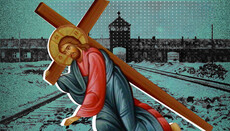
God within the child’s pain
If this is so, then God does not look upon a child’s suffering from a distant throne. He endures it from within the child’s own body. If we dare to speak of God as “powerless” to halt evil by force, then nowhere does this mystery become more terrible than here. This is a God who weeps with a child’s tears, who trembles with a child’s fear. This is not an answer to “why.” It is an answer to “where.” God is not above the suffering – He is in it. In a hospital ward. Beneath rubble. In the dark where a child is afraid.
St. Gregory the Theologian taught that in the Incarnation God united Himself with the whole of human nature. And if that is true, then every human pain echoes in God.
If God has entrusted Himself to humanity, then nowhere is that trust more fragile than in the life of a child. For a child, “God” is the one who protects, who warms, who gives meaning – the adult standing near. And so our calling becomes almost unbearable in its simplicity: when God seems silent, we must become His presence. If He does not act by force, then we must become His hands. Every act of saving a child is, in some mysterious sense, an act of restoring God’s image within a broken world.
An answer without words
To speak of a “powerless God” is to admit a terrifying truth: the world is so deeply fractured that even its Creator does not shatter its freedom in order to fix it. And so the only real answer to a child’s pain is not an argument, but a presence. An embrace. A voice that says: “I am here. I will not leave you.”
Ivan Karamazov rejected God because of the suffering of children. He returned his “ticket.” And Alyosha did not answer him with philosophy. He kissed him.
This is the limit of all reasoning. Before the suffering of a child, every system collapses into silence. Faith itself must become action. For in that moment, it seems as though God has lost – because He has chosen not coercion, not miracle, but love that suffers.
And yet, this is not the end.
How God overcomes evil
If we accept that God does not intervene “from above” to stop the hand of the tormentor or the course of disease, it may seem that evil has won the final move. That the game is over.
But within the framework of this “fragile” theology we are speaking of, God’s move is not the forceful suppression of evil, but something far more mysterious and profound. His answer lies not in preventing the act, but in what follows it – in its meaning and its ultimate transformation.
Following the insight of St. John Chrysostom and St. Gregory, God overcomes evil not by avoiding it, but by entering into it. When a child suffers, evil appears to triumph in the visible world. But if God is present within that suffering – if He feels the pain, bears the fear – then evil, in trying to consume the innocent, collides with God Himself.
It is as though pure light were brought into absolute darkness. The darkness cannot absorb it.
God “outplays” evil by refusing to let suffering be final.
He turns the dead end into a door.
In our world, a child’s suffering appears to be the ultimate defeat, because time erases everything. The child suffered, died, and the world went on. That is evil’s apparent victory – reducing a life to nothing. But in the divine consciousness, which is beyond time, that moment of suffering has not “passed away.” It is sealed forever. And God’s answer is this: He gathers every tear.
This is not merely a poetic metaphor. It is the affirmation that not a single second of a child’s pain will be discarded as waste. God “outplays” evil by ensuring that the last word spoken over the child will not be “pain,” but “restoration.” This belongs to eternity.
But even within earthly life, the suffering of one child can sometimes become the cause of spiritual change in others. Innocent suffering pierces the hard shell of human selfishness. It unleashes a wave of mercy and becomes fuel for love. Compassion is God Himself awakening within human hearts.
As Dostoevsky wrote, no harmony is worth the tear of a child. And God’s “answer” is not to explain that tear, but, at the end of all things, to wipe it away so utterly that the child himself will forgive this world. This is not “compensation” – like ice cream after an injection – but transfiguration. God’s answer is Resurrection.
The poet Paul Claudel spoke magnificently when he said: “God did not come to destroy suffering, nor did He come to explain it. He came to fill it with His presence.” St. Justin Popovich carries the same thought forward. God does not “allow” suffering while standing at a distance. He passes through it together with the child.
God is not the author of pain, but its hostage
And yet here a merciless question arises. Does this not mean that the suffering child becomes merely a passive instrument in the hands of divine providence? If we cling to the idea that “everything is by the will of God,” then the conclusion would seem inevitable: God is a tyrant, imposing suffering without consent.
But this is not so. Suffering is not imposed by God. It is imposed by a world in a state of fracture – by the freedom of evil, by the laws of biology, by chaos. In this situation, God is not the one who “gave the child an illness so that others might become kinder.” Such a being would be a monster.
God is the One who sits beside the child in that hospital room, horrified that the world is broken in so terrible a way.
Yes, the child did not choose this road. And that is the strongest argument against every attempt to “justify” pain. When Mother Maria Skobtsova freely chose her path into the gas chamber, it was a feat, because there was choice. In the case of the child, it is tragedy, because there is no choice. God does not “outplay” evil by using the child as a pawn. He “outplays” it by guaranteeing that pain will not have the final word.
The lesson of Janusz Korczak
When we speak of children, the finest “theologian” is not a philosopher, but the Polish educator Janusz Korczak. He did not speculate about the “powerlessness of God” – he embodied it. When the children from his orphanage were being led to the gas chambers of Treblinka, he was given a chance to save himself. He refused. He could not stop Hitler. He could not work a miracle.
What did he do?
He took the children by the hand, told them stories, and entered the chamber with them so that they would not be afraid. This is the answer: if God exists, then at the hour of a child’s suffering He is not “planning the salvation of the world” from afar – He is doing what Korczak did. He shares the horror so that the child will not be alone within it.
Is this a “justification”? No. It is only an attempt not to go mad before the meaninglessness of evil. God does not impose pain. He finds the child already within pain and says: “I am here.” Pain is evil. It does not automatically make the child “holy”; it wounds him, it destroys him. And God here is the only One who fully understands the depth of this injustice, because He lives through it in every cell of that child’s body.
God offers Himself in sacrifice because the world He created in freedom has turned into such a nightmare for the innocent.
And if we dare to believe that He does not yet crush evil by force, but walks with us through its darkness and promises that, in the end, Love will have the final word – then He is not a distant ruler.
He is our suffering Friend.
And our Savior.